How Magnetic Fields Work: Poles, Field Lines and Compasses
See how magnets push and pull through empty space, how field lines map the invisible, why a compass points north, and why the field fades so quickly with distance.
A magnet can move a paper clip without touching it. Something must reach across the gap, and physicists call that something a field. Learn how to read a field and you can explain compasses, fridge magnets, and why Earth itself acts like a giant bar magnet.
Poles and the two simple rules
Every ordinary magnet has two ends where the pull is strongest. We call them the north pole and the south pole. Cut a bar magnet in half and you do not get one north piece and one south piece. You get two smaller magnets, each with its own pair of poles.
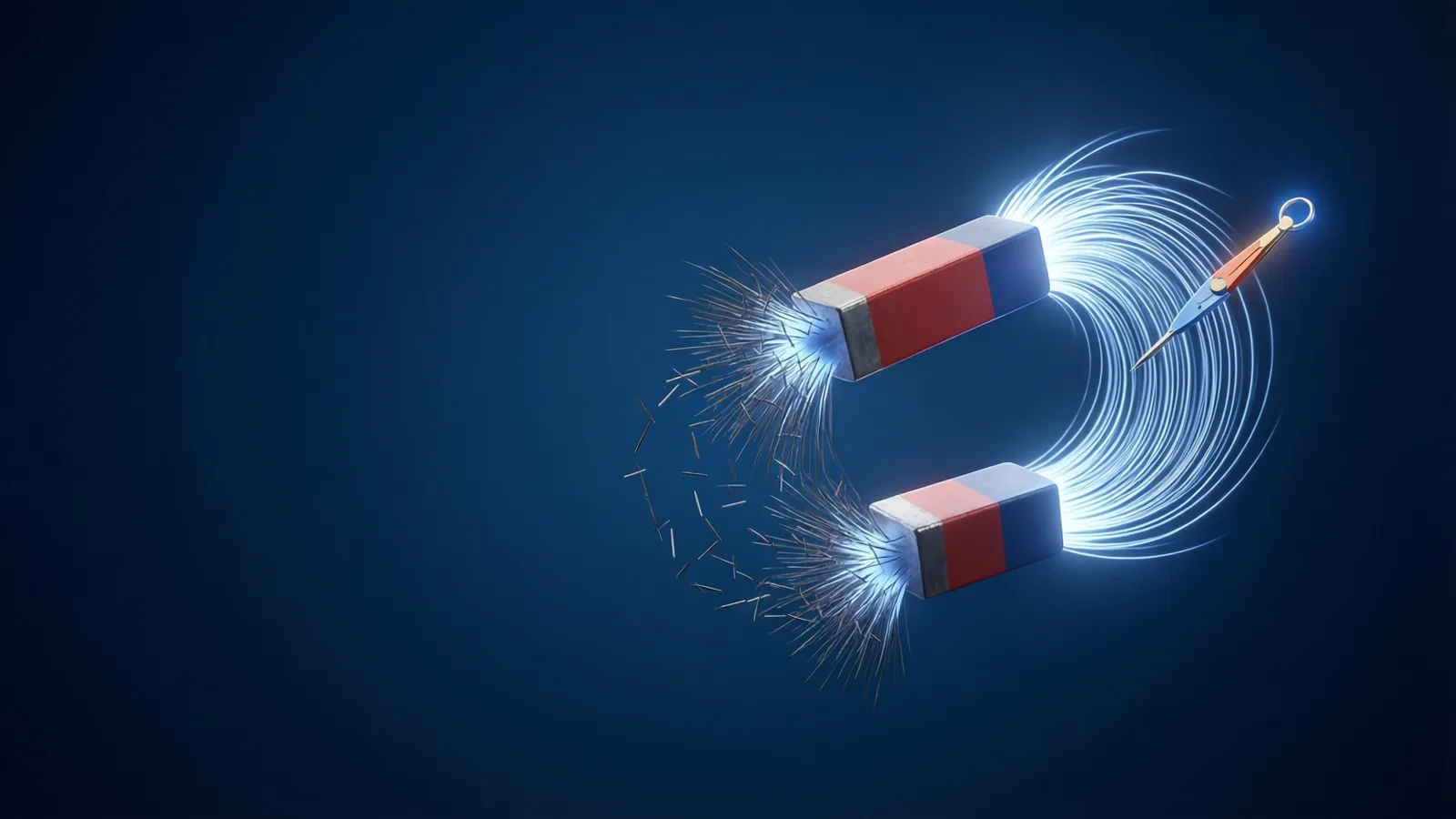
The forces between poles follow one tidy rule: like poles repel and unlike poles attract. Two north ends push apart, two south ends push apart, and a north end pulls toward a south end.
This is why a magnet can both attract and repel, something gravity never does. It also hints at why the poles always come as a pair: a magnet is a dipole.
What a magnetic field is
A magnet changes the space around it. At each point there is a magnetic field, written B, and it has both a strength and a direction. We measure it in tesla (T). A fridge magnet gives a few thousandths of a tesla near its surface. Earth's field at the ground is only about fifty millionths of a tesla.
Another magnet or a piece of iron placed in that space feels a force because of the field there. The field is the thing that carries the interaction across the gap. That is a more powerful idea than "the magnets pull on each other", because it works even when you remove the second magnet: the field is still there.
Reading field lines
We cannot see a field, so we draw field lines. A few rules make them easy to read:
- the line at any point shows the direction the field points there,
- lines run out of the north pole and into the south pole, and
- lines that are packed closely mean a stronger field, while spread-out lines mean a weaker one.
Sprinkle iron filings on paper over a bar magnet and each tiny filing turns into a mini magnet that lines up with the field. They gather into the same curved pattern the diagrams show, thick near the poles and thin far away. Field lines never cross, because the field at a point can only point one way.
Compasses read the field
A compass needle is a small magnet that can turn freely. Its north end swings to point along the local field. That makes a compass a field-direction detector, and it is how you can map a field one point at a time. Far from nearby magnets, the field it feels is Earth's, which is why the needle settles toward geographic north. Since opposite poles attract, the part of Earth near the north geographic pole behaves like a magnetic south pole.
Why the field fades so fast
Far from a small magnet, the field drops off as 1 / r³, where r is the distance from its centre. Double the distance and the field shrinks to one eighth. Triple it and you are down to one twenty-seventh.
The reason is the dipole structure. A magnet has a north and a south pole close together, and from far away their effects partly cancel. Compare this with the simpler 1 / r² rule for a single isolated source. A dipole has no single source to follow, so the leftover effect falls away faster.
This is why a strong magnet can lift a nail from a few millimetres away but has no effect from a metre. The simulation shows this as a field that thins out quickly the moment you move your probe away.
Adding fields and neutral points
When two magnets sit near each other, their fields add as vectors, point by point. This is called superposition. If two fields point the same way, they strengthen each other. If they point opposite ways with equal size, they cancel.
A spot where the total field is exactly zero is a neutral point. A compass placed there has no preferred direction, so the needle may settle in any orientation. You can find these spots by pointing two like poles at each other: the fields push against each other, and somewhere between the magnets they balance.
Common misconceptions
- "Magnets attract everything metal." Only a few materials, mainly iron, nickel and cobalt, respond strongly. Aluminium cans and copper coins do not stick.
- "A compass points to a pole of the magnet it is near." It points along the local field, which curves. Near a magnet it may point nowhere near the nearest pole.
- "Field lines are real strings." They are a drawing tool. The field exists everywhere, not only along the lines.
- "The Earth's north pole is a magnetic north pole." In magnet terms it is the opposite, as the compass logic above shows.
How to explore this in the lab
The Field Lab lets you place magnets, drag probes and see the 3D field. A suggested order through the free first world:
- Test the push and pull rule in Poles and forces.
- Draw the invisible with Field lines and iron filings.
- See why a needle swings in The compass and Earth's field.
- Measure the drop-off in Fields fade fast, then hunt for zeros in Neutral points.
The lab is a simplified teaching model with idealised magnets, so the shapes are cleaner than the messy fields of real, uneven magnets. The ideas still carry over.
- Like poles repel and unlike poles attract; poles always come in pairs.
- A field has strength and direction at every point, and field lines are a way to draw it.
- A compass points along the local field.
- A small magnet's field falls as 1/r³: double the distance, one eighth the field.
Poles and forces
Like poles repel, unlike poles attract. About 6 minutes. Free, no account, runs in your browser.
More free lessons from this guide
Simulations on Novareka are teaching models, simplified on purpose. They show how an idea behaves; they are not a substitute for professional, medical or engineering advice.
Labs in this guide
 Live
Live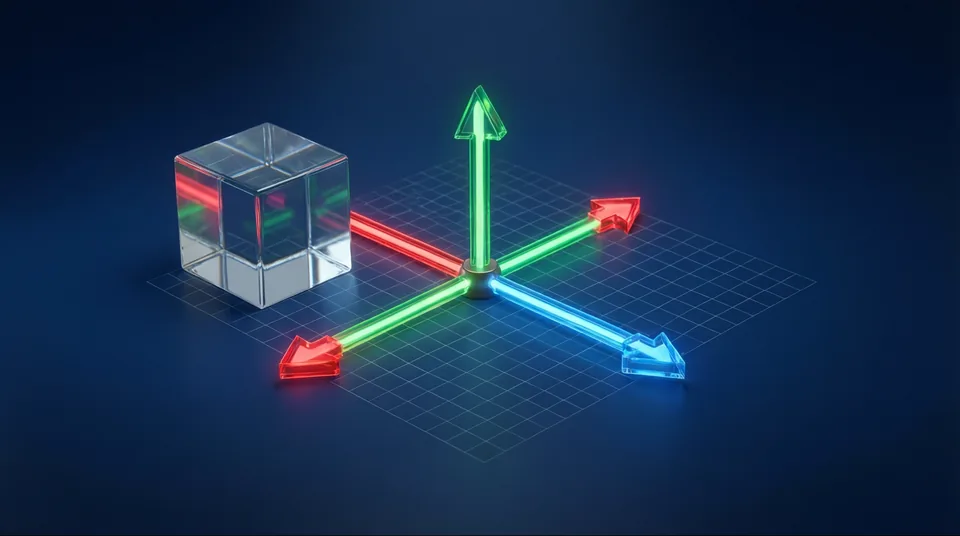 Live
Live Live
LiveKeep reading
All guides → Parents
 Parents
 Explainer