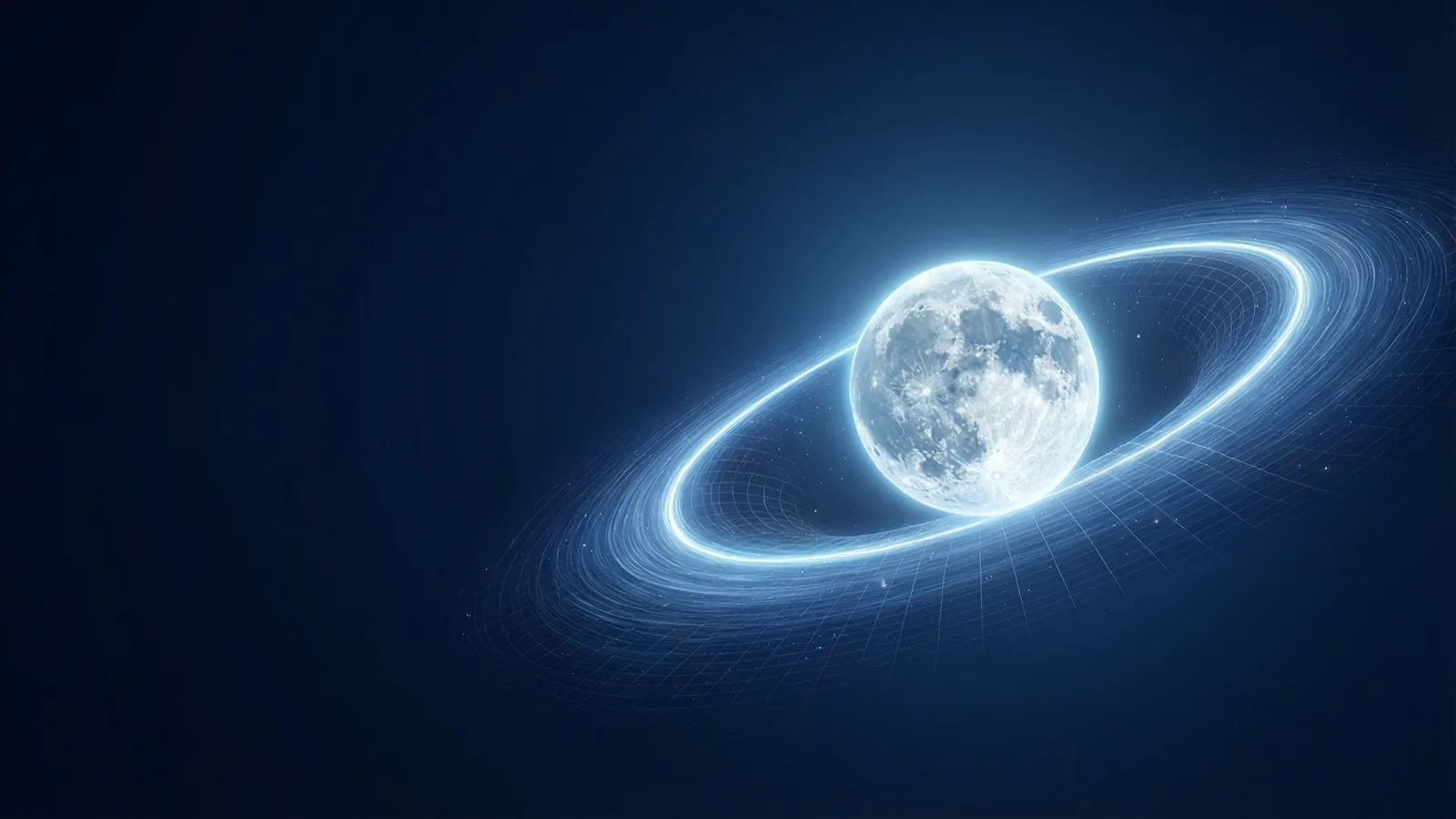
How Orbits Work: Falling Sideways Around a Planet
Why satellites never fall down, what sets orbital speed and escape velocity, and how Kepler’s three laws describe every bound orbit. With a live 3D orbit lab.
An astronaut on the space station is not floating because gravity switched off. At that height gravity is still almost as strong as on the ground. The station is falling the whole time, and it is moving sideways fast enough that it keeps missing the Earth. That one idea explains every orbit, from the Moon to a weather satellite.
An orbit is a fall that never lands
Picture throwing a ball horizontally from the top of a very tall tower. A gentle throw lands near the base. A harder throw lands farther away. Now imagine a throw so fast that, by the time the ball has dropped a little, the curved surface of the planet has also dropped away beneath it by the same amount. The ball is still falling, but the ground never arrives. That is an orbit.
So every orbit needs exactly two ingredients:
- a central mass whose gravity pulls the orbiting object inward, and
- a sideways velocity that carries the object around instead of straight down.
Without the sideways motion the object drops straight in; without gravity it coasts away along a straight path. Getting both at once is also why people inside a spacecraft feel weightless: they and their ship are falling together at the same rate.
The one speed that keeps an orbit round
At any distance from a planet there is exactly one speed that gives a perfectly circular orbit. For a small body around a much larger one, that circular speed is
v = √(GM / r)
where G is the gravitational constant, M is the planet’s mass and r is the distance from the planet’s centre (not from its surface).
The formula hides a surprise: the closer you orbit, the faster you must go. A satellite in low Earth orbit circles the planet in roughly an hour and a half, while the far-away Moon takes about four weeks. Slow down a little from the circular speed and the orbit becomes an ellipse that dips closer to the planet; speed up and it becomes an ellipse that swings farther out.
Escape velocity
Keep adding speed and at some point the object never comes back. That threshold is the escape velocity, √(2GM / r), which is always √2 (about 1.41) times the circular speed at the same distance. It does not depend on the mass of the thing escaping: a pebble and a spacecraft need the same speed from the same spot. In the idealised model it does not depend on direction either, as long as the path clears the surface.
Three possible fates from one launch
If you launch sideways from a fixed point and only change the speed, you get one of three outcomes:
- Too slow: the path is an ellipse that cuts into the planet, so the object crashes.
- In between: a closed orbit, circular at one special speed and elliptical otherwise.
- At or above escape velocity: the path opens up and the object leaves for good.
The quickest way to build intuition is to find those boundaries yourself: nudge the launch speed until a crash just turns into an orbit, then keep going until the orbit just opens into an escape. The free lesson Fall, orbit, or escape is built around exactly that experiment.
Kepler’s three laws in plain words
Johannes Kepler found the rules of planetary motion in the early 1600s, decades before Newton explained why they hold.
First law: orbits are ellipses
A bound orbit is an ellipse with the central body at one focus, not at the centre. A circle is simply an ellipse with no stretch. Two numbers describe the shape: the semi-major axis a (half the longest width, which sets the size) and the eccentricity e (0 for a circle, approaching 1 for a long, thin ellipse). The closest point is called periapsis and the farthest point apoapsis.
Second law: equal areas in equal times
A line from the planet to the orbiting body sweeps out equal areas in equal times. Because the line is short near periapsis, the body must move fast there; far out at apoapsis it moves slowly. This is conservation of angular momentum in disguise, and comets show it dramatically, racing past the Sun and then crawling through the outer solar system.
Third law: bigger orbits take much longer
The square of the period is proportional to the cube of the semi-major axis: T² ∝ a³. Double the size of an orbit and its period grows by about 2.8 times, not 2. With the full constant, T² = 4π²a³ / GM, the law becomes a scale: measure how long a moon takes to go round and how big its orbit is, and you can work out the mass of the planet it circles.
Common misconceptions
- “There is no gravity in space.” There is. At the height of the space station it is still around nine-tenths of its strength at the ground. Weightlessness comes from free fall, not from missing gravity.
- “Heavier satellites need to go faster.” The orbiting object’s own mass cancels out of the circular speed and escape velocity formulas (as long as it is tiny compared with the planet).
- “To catch up with something ahead of you, speed up.” Speeding up raises your orbit, and a higher orbit has a longer period, so you can end up falling behind.
- “Planets orbit in circles.” Most planetary orbits are close to circular, but they are ellipses, and some comets and asteroids follow very stretched ones.
How to explore this in the lab
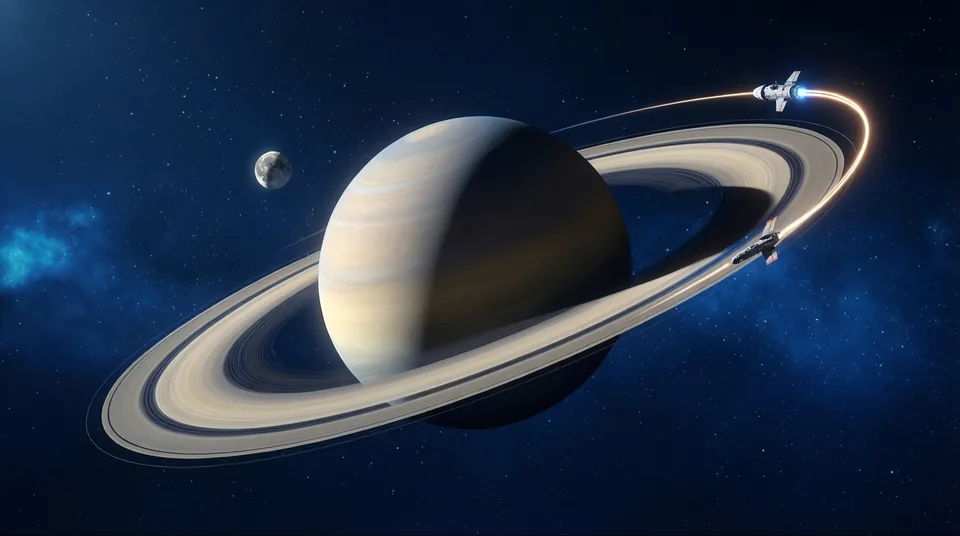
The Orbits & Gravity lab lets you launch a body around a planet and watch the path form in real time. A good order to work through the free first world:
- Start with What is an orbit? to see the falling-sideways idea in motion.
- Try Circular orbit speed and change the distance to see why closer orbits are faster.
- Push past the limit in Escape velocity.
- Stretch an orbit in Kepler’s First Law, then compare periods in Kepler’s Third Law.
Each lesson only counts as done when you meet the goal inside the simulation, so you are testing the physics rather than just reading about it. Keep in mind that the lab is a teaching model: it uses idealised two-body gravity with no air drag, so it shows the core behaviour clearly rather than predicting a real mission.
- An orbit is free fall with enough sideways speed to keep missing the ground.
- Closer orbits must be faster: circular speed is √(GM/r).
- Escape velocity is √2 times the circular speed at the same distance.
- Kepler: ellipses with the planet at a focus, equal areas in equal times, T² ∝ a³.
What is an orbit?
Falling forever, sideways. About 6 minutes. Free, no account, runs in your browser.
More free lessons from this guide
Simulations on Novareka are teaching models, simplified on purpose. They show how an idea behaves; they are not a substitute for professional, medical or engineering advice.
Labs in this guide
 Live
Live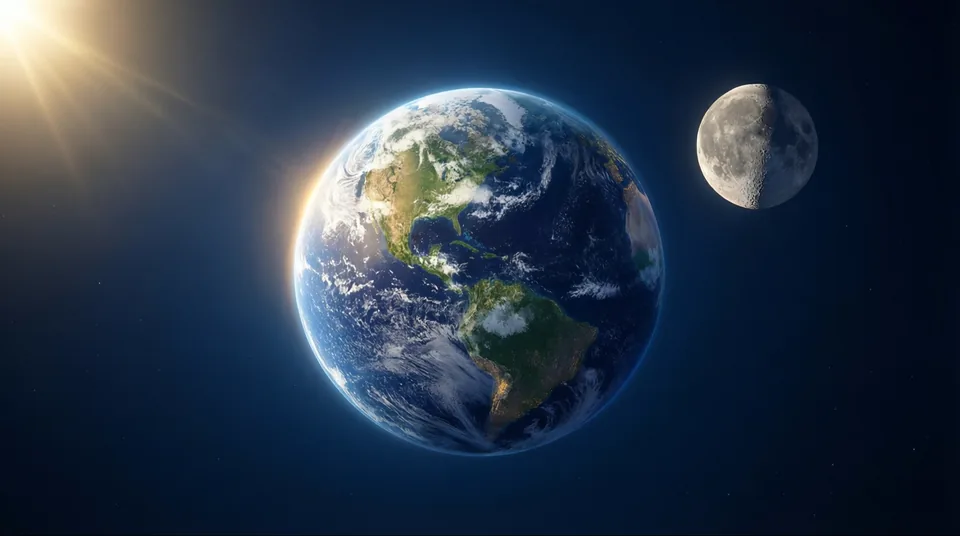 Live
Live Live
LiveKeep reading
All guides → Exam prep
 Explainer
 Explainer