Plate Tectonics Explained: From Wegener to Seafloor Spreading
How Earth’s layers, Wegener’s drifting continents and the discovery of seafloor spreading came together into the theory of plate tectonics.
Continents move about as fast as fingernails grow, yet over millions of years that is enough to open oceans and raise mountain ranges. The theory of plate tectonics ties earthquakes, volcanoes and mountains into one story. It starts with what the planet is made of.
What is Earth made of?
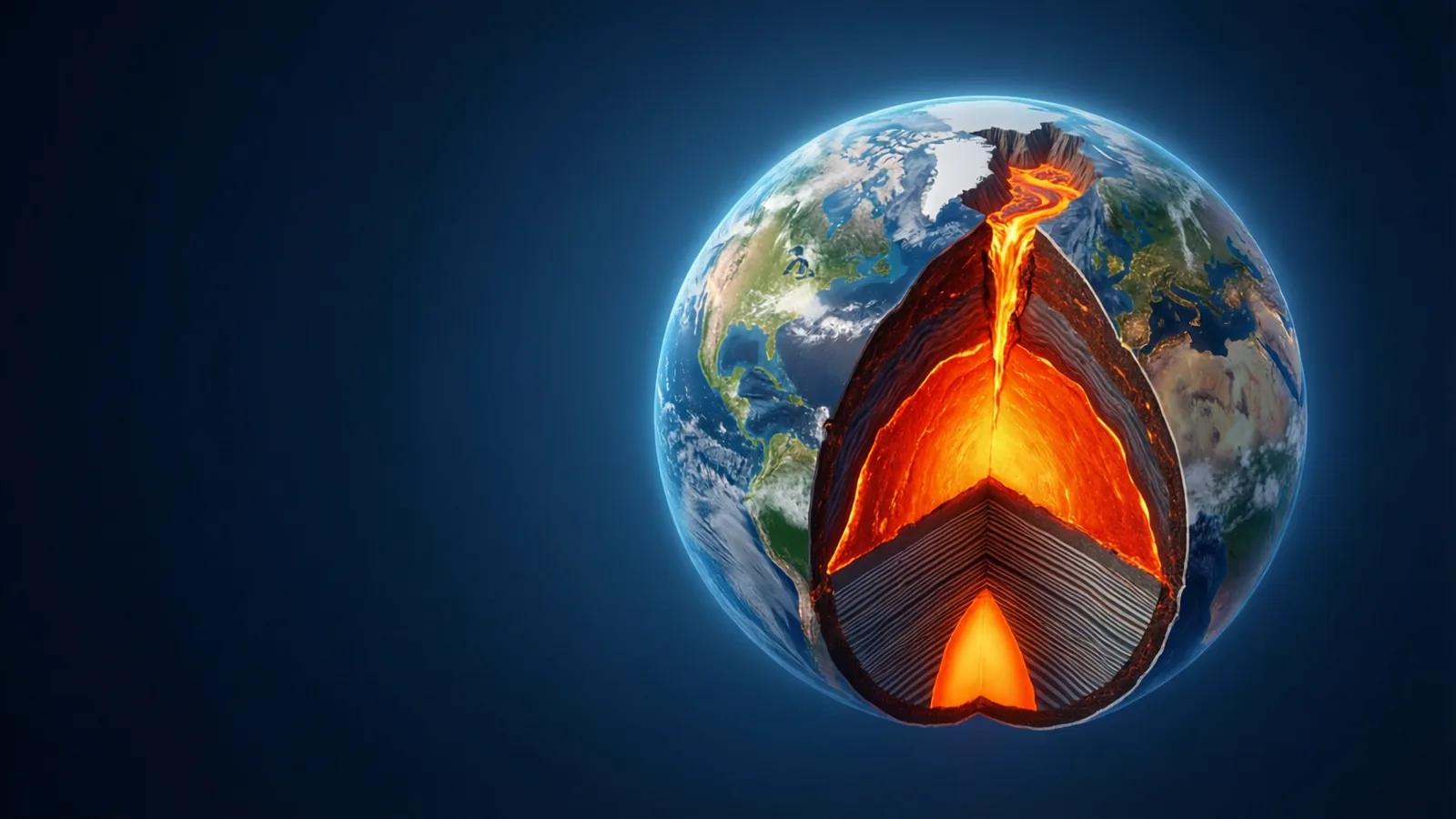
Earth is layered, a bit like an onion. From the outside in:
- Crust: the thin, cool, brittle skin we live on.
- Mantle: a thick layer of hot rock that flows very slowly.
- Outer core: liquid metal.
- Inner core: solid metal, kept solid by the immense pressure.
The crust comes in two types. Oceanic crust is thin, dark and made of dense basalt. Continental crust is much thicker and rich in lighter, granite-type rock. The key point is density: continental crust is less dense. That difference decides what happens whenever plates meet.
Why continents float high
Crust rides on the mantle in a way similar to a block of wood floating on water. This balance is called isostasy. Thick, light continental crust floats high and forms land. Thinner, denser oceanic crust sits lower and holds the oceans.
It also explains some slow changes. Remove a heavy load, such as an ice sheet, and the crust gradually rises. Add a load and it sinks a little.
Wegener’s jigsaw puzzle
In 1912, Alfred Wegener spotted that the Atlantic coasts of Africa and South America match like torn paper edges. He proposed that the continents had once been joined and had drifted apart. He backed the idea with several kinds of evidence:
- matching rock formations and mountain belts on opposite sides of the Atlantic
- the same fossil species found on continents now far apart
- signs of ancient glaciers in places that are warm today
Most scientists rejected him, and not because the evidence was weak. He could not explain what force could push continents through solid ocean floor. The idea needed a mechanism.
Wegener's picture also included Pangaea, a supercontinent that began breaking up about 200 million years ago. Supercontinents form and split in cycles lasting hundreds of millions of years.
The missing mechanism: seafloor spreading
The answer came from the ocean floor. At mid-ocean ridges, plates move apart and hot mantle rock rises. As the pressure drops, part of it melts, and the magma cools into new basalt crust.
The ocean floor therefore works like a slow conveyor belt. Rock is youngest at the ridge and gets older farther away. Later, cold, dense oceanic crust sinks back into the mantle at deep trenches. New crust is made in one place and destroyed in another, so the Earth is not growing.
Another clue came from paleomagnetism. When lava cools, iron-rich minerals record which way Earth's magnetic field pointed when the rock set, a kind of fossil compass. Read enough of them and you can estimate how far a rock has travelled in latitude and how it has been rotated. Symmetric stripes of magnetic records on both sides of a ridge fit the idea of crust being added in the middle.
A cracked shell: the plates
The rigid outer layer, made of the crust and the topmost mantle, is the lithosphere. It is split into roughly a dozen large plates plus many small ones, all sliding over the weaker, partly soft asthenosphere beneath.
Most earthquakes and volcanoes cluster along plate edges. There are three basic boundary types:
- Divergent: plates move apart, as at ridges and rifts.
- Convergent: plates move together, producing mountains, trenches and volcanic chains.
- Transform: plates slide past one another.
Heat from the core and from radioactive decay keeps the mantle moving in slow convection currents, which help drive plate motion, though they are not the whole story.
Common misconceptions
- "Continents plough through the ocean floor." Continents are carried along on plates.
- "The mantle is liquid." It is solid rock that flows slowly over geological time.
- "Plates move fast." Typical speeds are a few centimetres a year.
- "Pangaea was the first supercontinent." It is just the most recent well-known one.
- "Wegener was ignored for no reason." His evidence was strong; the mechanism was what was missing.
How to explore this in the lab
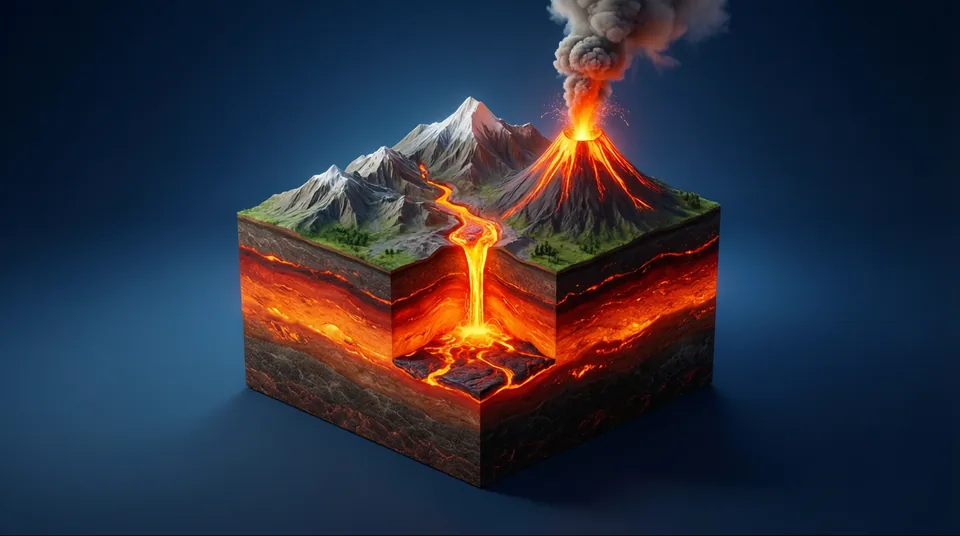
Today we do not have to infer plate motion, because GPS stations measure it directly. The Plate Tectonics lab is a simplified teaching model in which you can collide plates and open rifts yourself. A good route through the free lessons:
- Inside the Earth
- Two kinds of crust
- Wegener's puzzle
- Seafloor spreading
- Earth's plate mosaic and Watching plates move
For the other half of Earth's surface story, try the Weather Island lab.
- Earth has a crust, mantle, liquid outer core and solid inner core.
- Low-density continental crust floats higher than dense oceanic crust.
- Wegener had strong evidence for drift but no mechanism.
- New crust forms at ridges and sinks back at trenches.
- Plates move at a few centimetres a year, and GPS measures it.
Inside the Earth
Crust, mantle, core. About 5 minutes. Free, no account, runs in your browser.
More free lessons from this guide
Simulations on Novareka are teaching models, simplified on purpose. They show how an idea behaves; they are not a substitute for professional, medical or engineering advice.
Labs in this guide
 Live
Live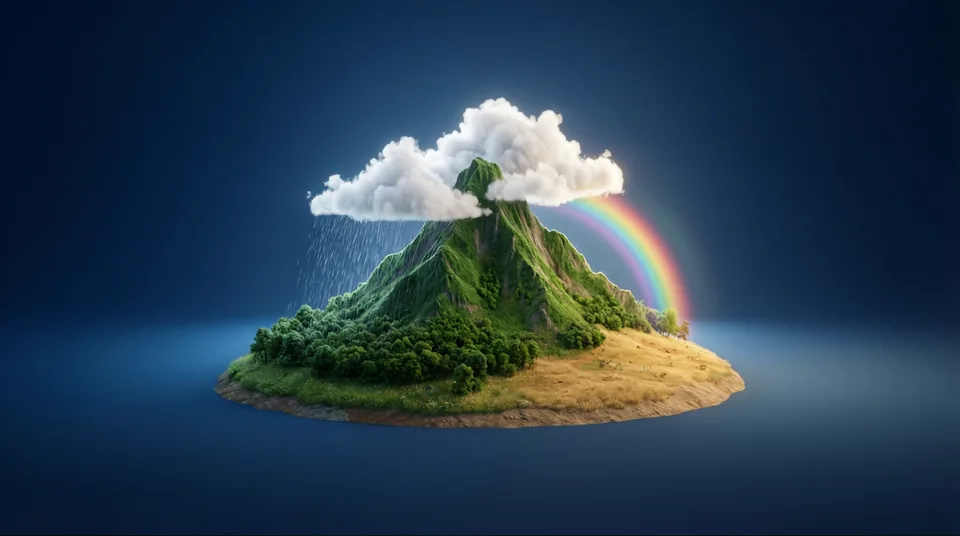 Live
Live Live
LiveKeep reading
All guides → Explainer
 Explainer
 Explainer