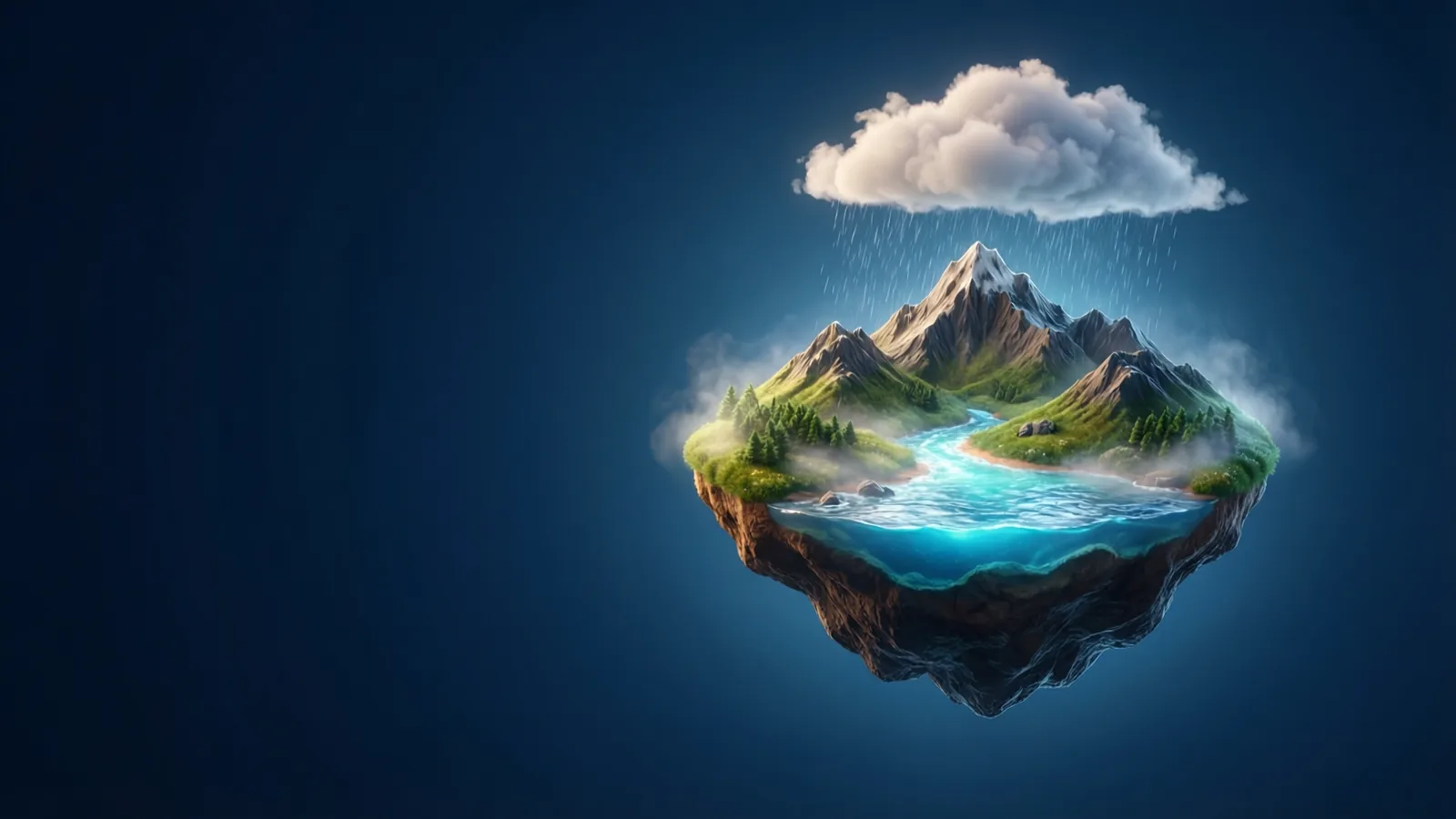
How the Water Cycle Works: A Simple Water Budget
Follow a drop of water through evaporation, condensation, precipitation and runoff, and learn why the total is conserved when water changes store.
The water you drink has been moving between sea, sky and land for a very long time. It is not made or destroyed in this journey; it just changes where it is stored and what state it is in. A simple budget of water units makes that easy to see.
A round trip for water
The water cycle is the circulation of water between the ocean, the atmosphere and the land. It runs on energy from the Sun. Four steps cover the main loop:
- Evaporation: sunlight gives liquid water enough energy to become invisible water vapour.
- Condensation: when air cools, vapour turns back into tiny liquid droplets, forming clouds.
- Precipitation: droplets grow until they fall as rain, snow or hail.
- Runoff: water flowing over land and through rivers returns to the ocean.
Notice that water vapour is a transparent gas. Clouds are not vapour. They are made of droplets or ice crystals, which is why you can see them.
Stores and flows
A useful way to think is in terms of stores and flows. The ocean, the atmosphere, rivers and lakes, soil, and ice are stores. Evaporation, condensation, precipitation and runoff are flows that move water from one store to another.
This framing keeps you from a common mistake. Rain does not "use up" the water in clouds. It moves water from the atmosphere store to the surface store. A later flow may move it again.
Conservation: where did the water go?
In a closed model the total amount of water stays the same. Suppose you start with 100 units spread over several stores. Whenever you move some, the amount leaving one store equals the amount entering another, so the sum is still 100.
That gives you a simple check for any water-budget problem:
total water = ocean + atmosphere + land + ice
If your numbers do not add up to the original total, something has been miscounted.
Cause and effect in the budget
Move 10 units from the ocean to the atmosphere by evaporation and the ocean loses 10 while the atmosphere gains 10. Precipitation then returns some to the land, and runoff returns it to the sea. Any step can be tracked on paper with simple subtraction and addition.
The simulation is a simplified teaching model with arbitrary units. Real catchments exchange water with neighbouring regions and with groundwater, and the timescales vary enormously, so this is a way to learn the logic, not a forecast.
Why the cycle is more than a loop
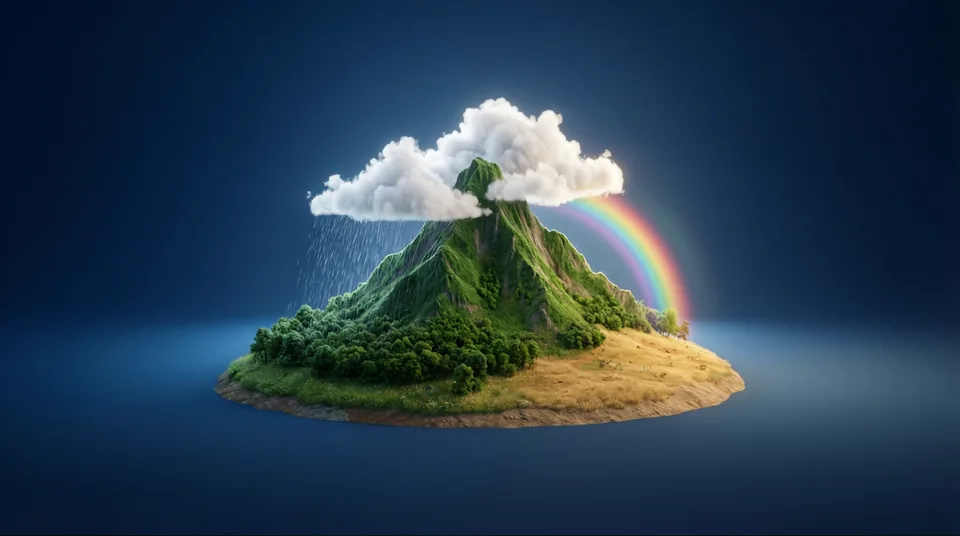
Geography shapes where the flows happen. Air rising over mountains cools, so condensation and precipitation are more common on the windward side. Descending air on the far side is drier, which creates a rain shadow. Wind direction, sea temperature and the shape of the land all change how a drop's journey unfolds.
Weather fronts, storms and seasonal rains are all ways the same budget plays out at different scales. Seeing the simple loop first makes these bigger patterns easier to follow.
A worked example with numbers
Take a toy world with 100 units of water: 97 in the ocean, 1 in the atmosphere, 2 on land. On a warm, sunny stretch, 3 units evaporate. Now the ocean holds 94, the atmosphere 4, the land 2. The total is still 100.
Next, the air cools and 3 of the atmosphere's units fall as rain over land. The atmosphere is back to 1 and the land holds 5. Finally, rivers carry 2 units to the sea: land 3, ocean 96. Add them up: 96 + 1 + 3 = 100.
Writing each step as "minus here, plus there" is the whole method. If you ever end up with a different total, you subtracted without adding somewhere. Real numbers differ greatly from this toy split, so treat the example as practice with the logic rather than a map of the planet.
Time matters too
Different stores hold water for very different lengths of time. Water in the atmosphere is replaced within days, while deep ocean water or glacier ice can stay put for centuries or longer. A store can have the same size and yet turn over much faster or slower, which is why a budget tells you quantities but not speeds.
Common misconceptions
- "Clouds are water vapour." Vapour is invisible; clouds are droplets or ice.
- "Rain removes water from the system." It only moves it.
- "The water cycle is a single neat circle." It has many branches and shortcuts.
- "Evaporation happens only when water boils." It occurs at any temperature, faster when warmer.
- "A water-budget model predicts tomorrow's weather." It does not; it tracks quantities.
How to explore this in the lab
Weather Island lets you shape a mountain, reverse the wind and watch moisture become clouds and rain. The two free lessons make a good start, in this order:
- A round trip for water to follow the loop and the changes of state.
- Where did the water go? to move units between stores and check that the total stays constant.
Predict first, then run it. For a look at the solid planet underneath the weather, visit the Plate Tectonics lab.
- The Sun powers evaporation, which feeds the rest of the cycle.
- Vapour is invisible; clouds are droplets or ice crystals.
- Water moves between stores; it is not used up.
- In a closed budget, the total stays the same.
A round trip for water
About 7 minutes. Free, no account, runs in your browser.
More free lessons from this guide
Simulations on Novareka are teaching models, simplified on purpose. They show how an idea behaves; they are not a substitute for professional, medical or engineering advice.
Labs in this guide
 Live
Live Live
Live Live
LiveKeep reading
All guides → Explainer
 Explainer
 Explainer