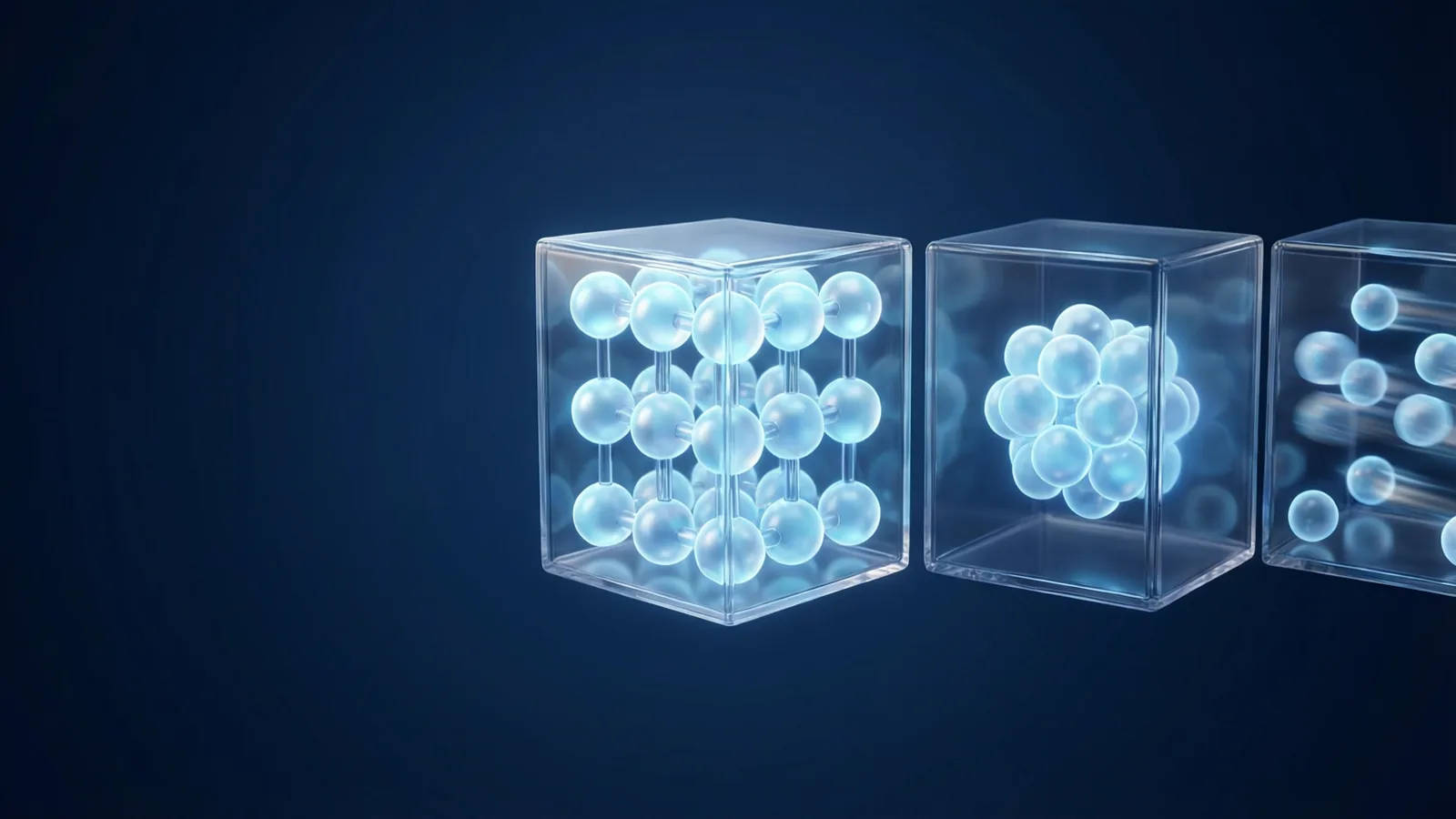
States of Matter: The Particle Model of Solids, Liquids, Gases
See why ice, water and steam are the same particles in different states: how heat sets speed, why liquids evaporate and boil, and why cooling builds crystals.
Ice, water and steam look nothing alike, yet they are made of exactly the same molecules. The difference is not what the particles are but how they move and how tightly they cling together. The particle model turns that into a picture simple enough to predict melting, boiling and freezing.
One substance, three behaviours
The particle model says all matter is made of tiny particles that are always moving and that attract each other when close. Two things decide the state you see:
- how fast the particles move, which is tied to temperature, and
- how strongly they hold on to their neighbours, which depends on the material.
A solid keeps its shape because its particles vibrate in fixed positions. A liquid flows because its particles slide past each other while still staying close. A gas fills any container because its particles are far apart and race around, barely attracting each other.
Heat does not change the particles themselves. Water molecules in ice are the same as in steam.
Temperature is movement
Temperature is a measure of the average motion energy of the particles. Warm a solid and its particles jiggle harder. Warm it enough and the jiggling beats the attraction that holds them in place. The solid melts.
Keep adding heat and, eventually, particles gain enough energy to escape the liquid altogether. This is why the same material can be a solid, a liquid or a gas without changing identity: it only depends on the balance between motion and attraction.
During a change of state the temperature of a pure substance stays flat even while you keep heating. The energy goes into loosening the grip between particles instead of making them move faster.
Evaporation and boiling
Particles in a liquid do not all move at the same speed. Some are quick, some slow, and the average is the temperature. At any temperature a few of the fastest particles near the surface have enough energy to break free of their neighbours and leave. That is evaporation, and it is why a puddle dries on a cool day.
Evaporation also explains cooling: the fastest particles leave, so the average energy of those left behind drops.
Boiling is different. As a liquid gets hotter, its tendency to escape (its vapour pressure) rises. Boiling starts when that push from inside matches the pressure of the surroundings. At that point bubbles of vapour can form throughout the liquid, not just at the surface. That is also why water boils at a lower temperature when the surrounding pressure is lower.
Freezing and order
Take energy out and the movement slows. The particles can no longer shrug off their neighbours' pull, so they settle into the arrangement that costs the least energy. For many simple substances that is a crystal: a neat repeating pattern where each particle sits snugly among others.
In the close-packed crystal in the simulation, each particle inside has 12 nearest neighbours. Particles on the surface have fewer, which is one reason surfaces behave differently from the bulk.
Water is a special case. Its molecules form a more open structure when they freeze, so ice is less dense than liquid water and floats. The lab uses simple, generic particles, so it shows the common pattern rather than water's quirks.
What the simulation is actually doing
The lab does not draw a cartoon of particles. It runs molecular dynamics: it applies Newton's laws to every particle in very small time steps. The force between two particles comes from a simple recipe in which they push hard apart when they overlap and pull gently together at a moderate distance.
From those rules alone, the behaviour you saw above appears by itself. Heat the box and the structure loosens; cool it and a crystal forms. Nobody tells the particles to form a solid or a gas. It emerges from motion and attraction, which is a strong reason to trust the model.
This is still a simplified teaching model with a few hundred particles and idealised forces, so numbers such as exact melting points belong to real materials, not to the box.
Common misconceptions
- "Particles in a solid do not move." They vibrate constantly; they just stay near fixed positions.
- "Hot particles expand." Heating changes how they move and how far apart they sit on average, not the size of each particle.
- "Bubbles in boiling water are air." They are water vapour, the gas state of water itself.
- "There is nothing between gas particles." There is empty space, which is why gases are easy to compress.
- "Steam is the white cloud you see." The visible cloud is tiny liquid droplets; true steam is invisible.
How to explore this in the lab
The Particle Lab puts a box of interacting particles in your hands, with a heater you can raise and lower. A suggested order through the free first world:
- Start with Everything is made of moving particles and melt the crystal.
- Watch the escape in Boiling and evaporation.
- Cool it down in Freezing and order.
- Peek under the hood in Inside view: molecular dynamics.
Try changing one thing at a time and describing the particle picture in your own words before you move on. If you can explain what the particles are doing, you really understand the state.
- States differ by particle motion and attraction, not by the particles themselves.
- Temperature measures average motion energy of the particles.
- Evaporation happens at any temperature; boiling starts when vapour pressure matches the surroundings.
- Cooling lets attraction win and particles settle into an ordered crystal.
Everything is made of moving particles
Melting, seen from the inside. About 7 minutes. Free, no account, runs in your browser.
More free lessons from this guide
Simulations on Novareka are teaching models, simplified on purpose. They show how an idea behaves; they are not a substitute for professional, medical or engineering advice.
Labs in this guide
 Live
Live Live
Live Live
LiveKeep reading
All guides → Parents
 Explainer
 Explainer