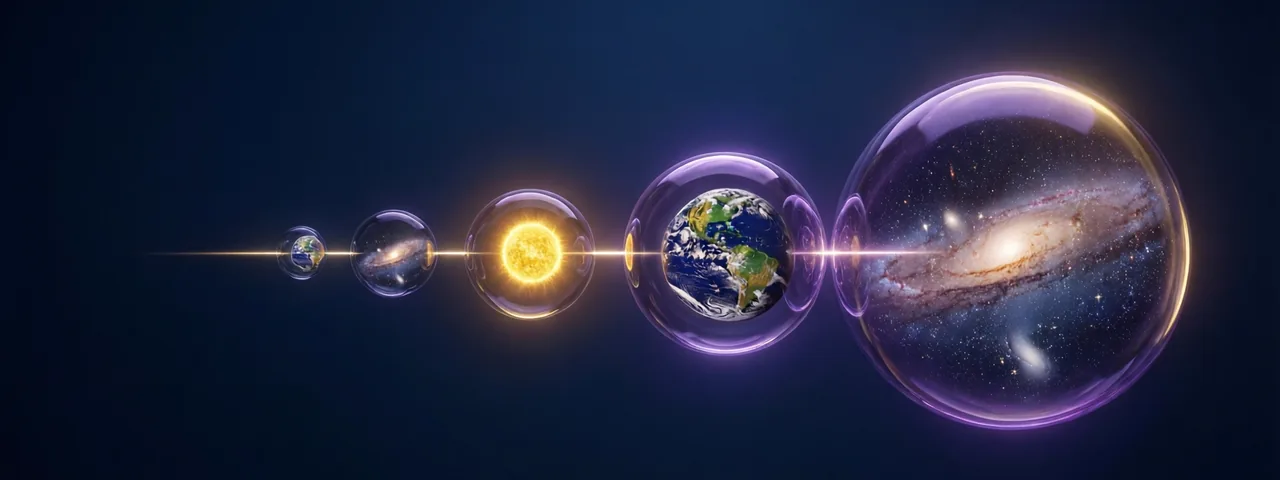
Zooming out: powers of ten
Twenty-seven steps from your room to the universe
Teaching this? Open projector mode
Astronomy deals with numbers that are far too big for everyday words. The trick is to count in powers of ten.
Each step up the ladder multiplies the size by 10. One step is called one order of magnitude. We write the steps with an exponent: 10³ is 1,000, 10⁶ is 1,000,000, and 10⁰ is 1 (the room you are sitting in is a few metres, so about 10⁰ m).
Here is a ladder of real sizes. The numbers are rounded, because we only want the right order of magnitude.
| Object | Size or distance | About |
|---|---|---|
| A room, a person | 1 to 5 m | 10⁰ m |
| Earth (diameter) | 1.27 × 10⁷ m (12,700 km) | 10⁷ m |
| Sun (diameter) | 1.39 × 10⁹ m | 10⁹ m |
| Earth to Sun (1 astronomical unit, AU) | 1.5 × 10¹¹ m | 10¹¹ m |
| The Solar System out to Neptune's orbit (diameter) | about 9 × 10¹² m | 10¹³ m |
| One light-year | 9.46 × 10¹⁵ m | 10¹⁶ m |
| The Milky Way (diameter) | about 10⁵ light-years, roughly 10²¹ m | 10²¹ m |
| The observable universe (diameter) | about 93 billion light-years, roughly 9 × 10²⁶ m | 10²⁷ m |
From your room to the observable universe is about 27 steps. Earth is 7 steps from you, but the universe is a further 20 steps beyond Earth.
Why a log scale? On an ordinary ruler the universe would be so long that Earth would be an invisible dot. On a logarithmic scale every step of ten gets the same amount of room, so you can see everything at once. That is why the zoom scene in this lab has a log scale bar, and why you will see bars labelled 10⁰ to 10²⁷ in this course.
Choosing a unit. Pick the unit that keeps the number small and friendly:
- kilometres for cities and planets,
- astronomical units (AU) inside the Solar System (Neptune is about 30 AU from the Sun),
- light-years between stars (next lesson),
- parsecs (3.26 light-years each), kiloparsecs and megaparsecs between galaxies.
You can picture it after all. Shrink Earth to a 1 cm marble. On that scale the Moon is a small ball about 30 cm away, the Sun is a ball about 1.1 m wide placed about 120 m down the road, and Neptune is about 3.5 km away. The nearest other star, Proxima Centauri, would be about 31,000 km away, which is most of the way around the real Earth. A scale model does what a big number cannot: it lets you compare.
About how wide is Earth, to the nearest power of ten?
One step up the ladder of powers of ten means the size is...
Neptune is about 30 times farther from the Sun than Earth is. Which unit is handiest for that distance?
Which unit suits the distance between two neighbouring stars?
"Space is so big that we cannot picture it at all, so there is no point comparing sizes." What is a better view?