The spinning magnet
How a generator works
Teaching this? Open projector mode
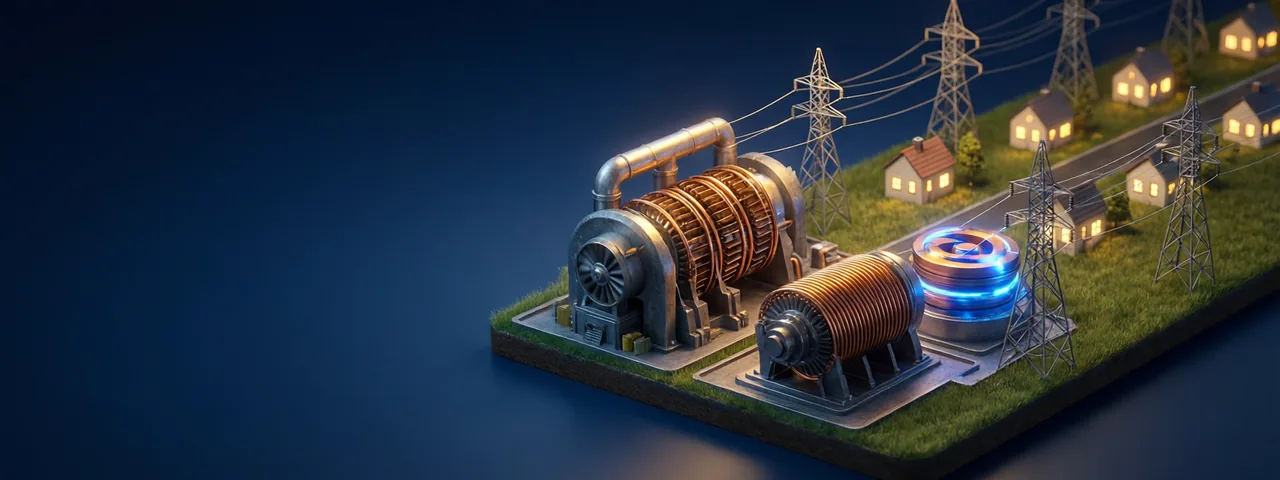
Almost every big power station, whatever its fuel, does one job at the end of its chain: it spins a generator. Steam turns a turbine in a coal, gas or nuclear plant. Falling water turns a turbine in a hydro plant. Wind turns a rotor on a wind turbine. The generator turns that rotation into electric current.
The one big exception on the island is the solar panel. It makes electricity directly from light, with nothing spinning. World 3 explains how.
The principle is electromagnetic induction, discovered by Michael Faraday in 1831. When the magnetic flux through a loop of wire changes, an EMF (a voltage) appears in the loop. Faraday's law:
ε = −N × dΦ / dt
Here N is the number of turns of wire, and dΦ/dt is how fast the flux changes. The minus sign says the induced current opposes the change (Lenz's law), which is why the machine feels heavy to turn: the energy comes from whatever is doing the turning. Field Lab, in its Induction world, goes deeper into flux, and its Motors & generators world takes a generator apart.
Spin a magnet near a coil. As the magnet turns, the flux through the coil rises, falls, reverses and rises again. The EMF follows it as a smooth wave, a sine wave, which is alternating current (AC).
For a coil of N turns and area A turning at angular speed ω in a uniform field B, the peak EMF is ε_peak = N × B × A × ω. Worked example (an assumed coil): N = 100 turns, B = 0.5 T, A = 0.01 m², turning at 50 revolutions per second, so ω = 2π × 50 ≈ 314 rad/s.
ε_peak = 100 × 0.5 × 0.01 × 314 ≈ 157 V. The usual household figure is the RMS value, the peak divided by √2: about 111 V. Turn faster, add turns or use a stronger magnet, and the voltage rises.
Why 50 or 60 Hz? The frequency of the output depends on the rotation speed and the number of magnetic poles:
f = p × n / 60
where f is in hertz, n is the rotation speed in revolutions per minute (rpm), and p is the number of pole pairs (a 2-pole machine has p = 1, a 4-pole machine has p = 2).
- 50 Hz with 2 poles (p = 1): n = 50 × 60 / 1 = 3,000 rpm.
- 50 Hz with 4 poles (p = 2): n = 50 × 60 / 2 = 1,500 rpm.
- 60 Hz with 2 poles: 3,600 rpm. With 4 poles: 1,800 rpm.
Different parts of the world chose 50 Hz (most of Europe, Africa and Asia) or 60 Hz (North America and some other countries). The two systems cannot be wired together directly.
Why must something spin the generator?
A 4-pole generator (p = 2) turns at 1,500 rpm. What frequency does it make?
Which common power source has NO spinning generator?
What is wrong with saying 'a power station creates electricity from nothing'?