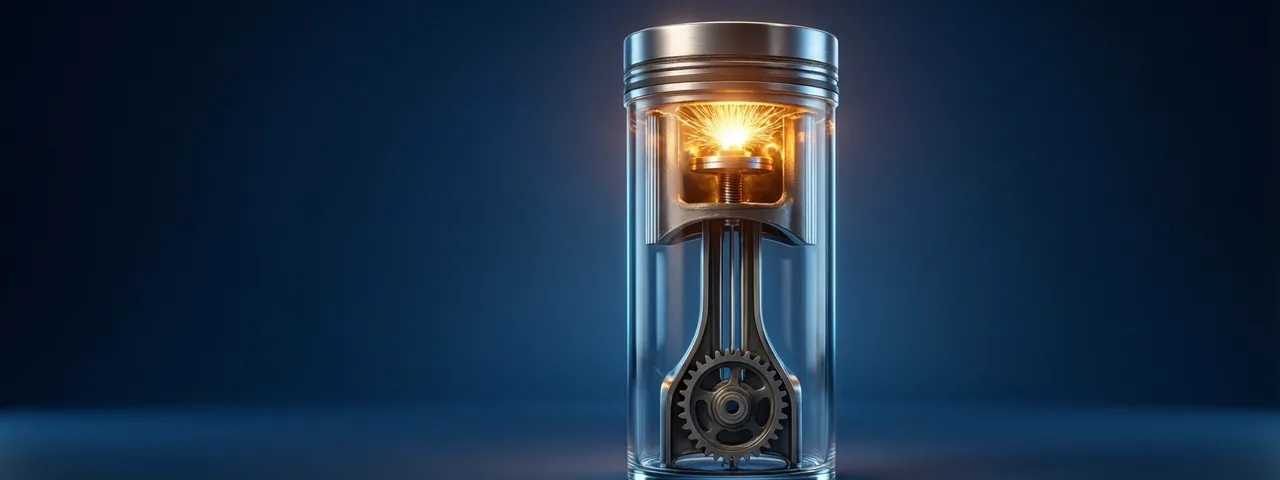
Four strokes: intake, compression, power, exhaust
The cycle that repeats every two turns
Teaching this? Open projector mode
In most cars the piston repeats the same four-stroke cycle again and again. The name comes from the four piston strokes it takes:
1. Intake. The intake valve opens and the piston moves down, drawing fresh air in. In a port-injection petrol engine fuel is sprayed into the incoming air; in a direct-injection engine it is sprayed into the cylinder itself.
2. Compression. Both valves are closed. The piston moves up and squeezes the gas into a much smaller space. Squeezing makes it hot and sets it up to burn.
3. Power. Near the top of the compression stroke the spark plug fires. The mixture burns, the hot gas expands and pushes the piston down. This is the only stroke that delivers energy to the crankshaft. Both valves are still closed.
4. Exhaust. The exhaust valve opens and the piston moves up, pushing the burnt gas out. Then the cycle begins again.
Count the crank turns: each stroke is half a turn (180°), so a cycle is 4 × 180° = 720°, which is two full turns of the crankshaft. The camshaft, which opens the valves, only needs to open each valve once per cycle, so it turns at half the crankshaft speed, one turn per cycle. In an engine it is driven by a belt or chain with a 2 : 1 gear ratio.
This also means a single cylinder gets one power stroke every two turns, not one every turn. At 3 000 rpm the crankshaft makes 50 turns a second, so one cylinder fires 25 times a second.
Where does the energy come from for the other three strokes? From the flywheel, and in a multi-cylinder engine from the other cylinders, which are on their own power strokes. The intake, compression and exhaust strokes all take a little work to pump gas around and to squeeze it.
If you plot the gas pressure against the cylinder volume through the cycle you get a loop, the P–V diagram. The area inside the loop is the net work per cycle. The Particle Lab's Heat Engines world draws that diagram for the Otto cycle and derives its efficiency; here we only watch the loop being traced as the piston moves.
Some small engines (lawn mowers, chainsaws, small scooters) are two-stroke: they fire on every turn by combining the strokes, which makes them light and simple but harder to keep clean. Cars almost always use the four-stroke cycle because it controls the gas exchange better.
During which two strokes are both valves closed?
How many turns does the crankshaft make in one complete four-stroke cycle?
Which stroke pushes the burnt gas out of the cylinder?
Is it true that a four-stroke engine does useful work on every turn of the crankshaft?