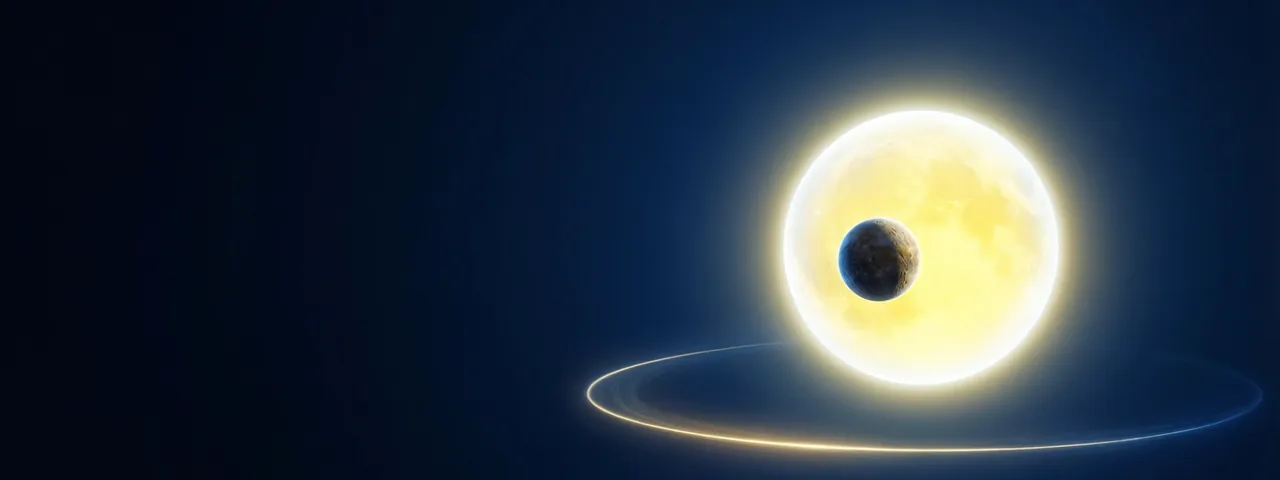
A faint world next to a blinding star
Why almost no exoplanet is photographed
Teaching this? Open projector mode
An exoplanet is a planet that orbits a star other than the Sun. The nearest star beyond the Sun, Proxima Centauri, is about 4.24 light years away, so every exoplanet is far beyond anything a spacecraft has visited. Everything we know about them comes from light that has travelled for years.
Why not simply photograph them? A planet makes no light of its own that matters in visible colours. It shines only by reflecting its star’s light, and it reflects only a tiny fraction of it.
A rough estimate of the contrast (planet brightness divided by star brightness) is
contrast ≈ (Rp / 2a)² × albedo
where Rp is the planet’s radius, a is its distance from the star and the albedo is the fraction of light it reflects. For an Earth-like planet at 1 AU around a Sun-like star the result is about 10⁻¹⁰: the star outshines the planet by roughly ten billion times. For Jupiter at 5.2 AU it is about 10⁻⁹, a billion times. This is for reflected visible light only.
The planet is also very close to its star in the sky. At a distance of 1 parsec (3.26 light years) one AU looks like 1 arcsecond, so the angle in arcseconds is θ = a (in AU) ÷ d (in parsecs). From 10 parsecs an Earth-like orbit at 1 AU is only 0.1 arcsecond across. Jupiter’s orbit seen from 30 light years (9.2 parsecs) has a radius of 5.2 ÷ 9.2 ≈ 0.57 arcsecond. A glare ten billion times brighter than the planet, 0.1 arcsecond away, is a very hard thing to see past.
Two things make the job easier. First, planets that are young, hot, giant and far from their star glow with their own heat, mostly in the infrared, so their contrast is far better than 10⁻⁹. The four giants of the HR 8799 system, imaged in 2008 and later, are the classic example. Second, a coronagraph is a small mask inside a telescope that blocks the star’s light before it reaches the detector. A starshade is the same idea in space: a large screen flying far in front of the telescope. A mask that is too big hides the planet as well, so the planet has to be far enough from the star to sit outside it.
Seen in visible light, roughly how many times brighter is the Sun than the Earth would look from far away?
Which planet is the easiest to photograph directly?
What does a coronagraph do?