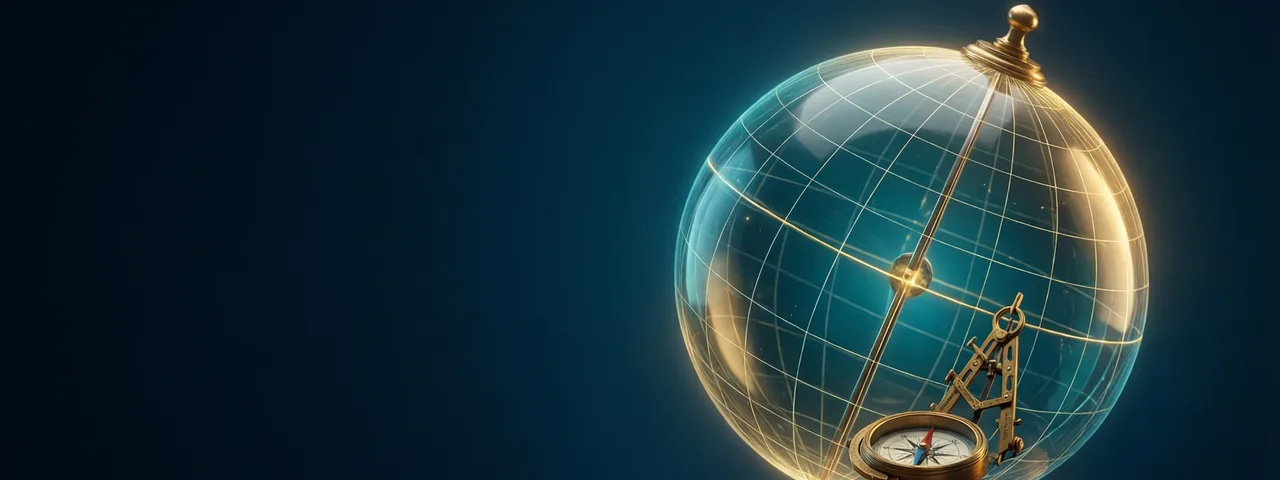
A grid for a sphere
Latitude, longitude and where they start
Teaching this? Open projector mode
A flat sheet of squared paper has an easy address system: go along, then go up. A ball has no edges and no corners, so it needs a different plan. The plan people settled on uses the one thing the Earth already has: a spin axis. The two places where the axis comes out are the North Pole and the South Pole.
Halfway between the poles, all the way round, runs the Equator. It is the natural starting line for one of our two numbers.
Latitude says how far north or south of the Equator you are. It is an angle, measured at the centre of the Earth. The Equator is 0°, the North Pole is 90° N and the South Pole is 90° S. Points with the same latitude form a circle round the globe called a parallel. Parallels never meet, and they get smaller as you move towards the poles.
Longitude says how far east or west you are. It is also an angle at the centre of the Earth, measured round the axis, from 0° to 180° east or west. Points with the same longitude lie on a half-circle from pole to pole called a meridian. Unlike parallels, meridians all meet at the poles.
There is something odd about the two starting lines. The Equator is chosen by nature: it is the circle halfway between the poles. But nothing in nature picks a 0° meridian. Any pole-to-pole line could have been the start. Sailors and mapmakers used different ones for centuries.
In 1884 an International Meridian Conference in Washington agreed to use the meridian through the Royal Observatory at Greenwich, London. It is a convention, not a discovery. That is why the Prime Meridian is at Greenwich and, on the far side of the world, the 180° meridian is where the longitudes of east and west meet.
Which of these is a line of latitude?
How many degrees of latitude separate the Equator from a pole?
Why does the Prime Meridian run through Greenwich?