Push back to go forward
Newton’s third law
Teaching this? Open projector mode
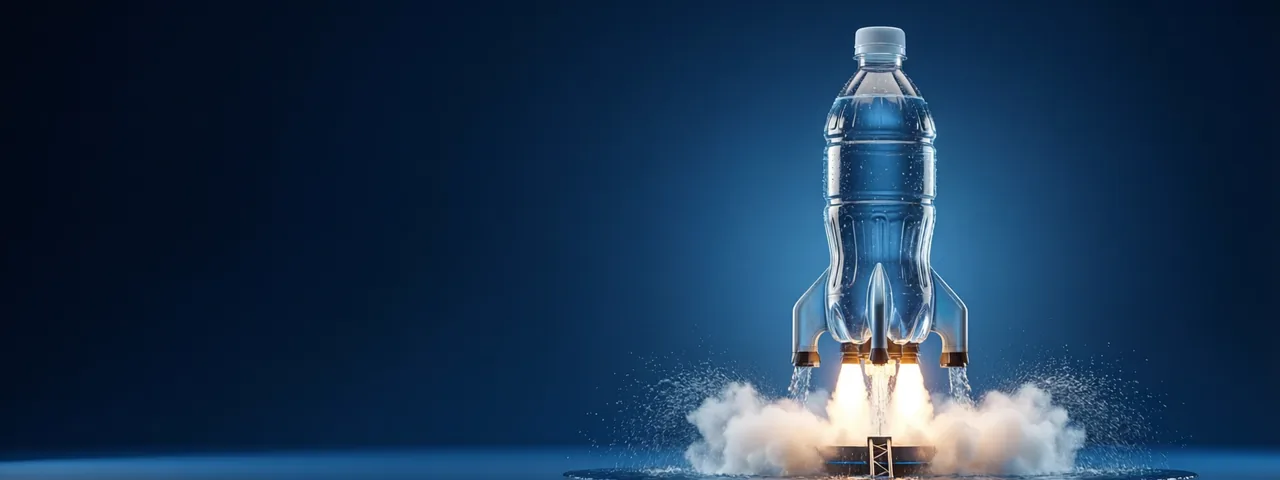
A rocket moves by throwing mass backwards. That is the whole trick. Whatever the rocket throws out (hot gas from a real rocket, a jet of water from a bottle rocket) is called the exhaust. When the rocket pushes the exhaust backwards, the exhaust pushes the rocket forwards.
This is Newton’s third law: when object A pushes on object B, object B pushes back on A with a force of equal size and opposite direction. The two forces are a pair. They act on different objects, so they do not cancel each other. The push on the exhaust makes the exhaust accelerate backwards; the push on the rocket makes the rocket accelerate forwards.
The same idea can be written with momentum, which is mass times velocity (p = m v). If nothing outside pushes on the system, its total momentum cannot change. A rocket and its exhaust start at rest, so their total momentum starts at zero and stays zero:
m_rocket × v_rocket + m_exhaust × v_exhaust = 0, so m_rocket × v_rocket = −m_exhaust × v_exhaust
The minus sign says the two velocities point in opposite directions.
A thought example with no rocket at all: a 60 kg skater standing on very smooth ice throws a 3 kg ball forwards at 10 m/s. The ball gains 3 × 10 = 30 kg·m/s, so the skater must gain the same amount backwards: v = 30 ÷ 60 = 0.5 m/s the other way. A rocket is this skater throwing a very small ball, again and again, extremely fast.
What does the rocket push against? Not the air, and not the ground. It pushes against its own exhaust, which it carries along. That is why a rocket works in empty space, where there is nothing else to push on. In fact it works slightly better there, as you will see in World 4.
This was once a surprise to some people. In 1920 a newspaper editorial doubted that a rocket could work in space, because it would have “nothing to push against”. The same newspaper printed a correction in July 1969, while Apollo 11 was on its way to the Moon.
Why can a rocket work in empty space?
In a water rocket, the reaction force from the water jet acts on which object?
Do the two forces of an action–reaction pair act on the same object?