The Coriolis spin: why storms rotate
The deflection that turns a draught into a storm
Teaching this? Open projector mode
Air flows towards a low-pressure centre, so why do tropical cyclones spin instead of just filling in? The answer is that we live on a rotating planet.
Earth turns once in about 24 hours, so Ω = 7.292 × 10⁻⁵ rad/s. When you describe motion from the rotating Earth's point of view, a moving object appears to be pushed sideways by an apparent force called the Coriolis effect. Watching from outside, nothing is pushing it; the ground is turning underneath it. In the rotating frame the acceleration is a = −2 Ω × v, which is always at right angles to the motion.
For motion along the ground, what matters is the part of Earth's rotation that is vertical at your latitude φ. That gives the Coriolis parameter
f = 2 Ω sin φ
- At 45° latitude: f = 2 × 7.292 × 10⁻⁵ × 0.707 ≈ 1.03 × 10⁻⁴ s⁻¹.
- At the poles (90°): f is largest, about 1.46 × 10⁻⁴ s⁻¹.
- At the equator (0°): f = 0. There is no sideways push for horizontal motion.
The push is tiny. A 10 m/s wind at 45° feels an acceleration f × v of only about 0.001 m/s², about ten thousand times weaker than gravity. It matters because winds and ocean currents act over hours, days and thousands of kilometres.
Which way? In the Northern Hemisphere moving air is deflected to the right. In the Southern Hemisphere it is deflected to the left.
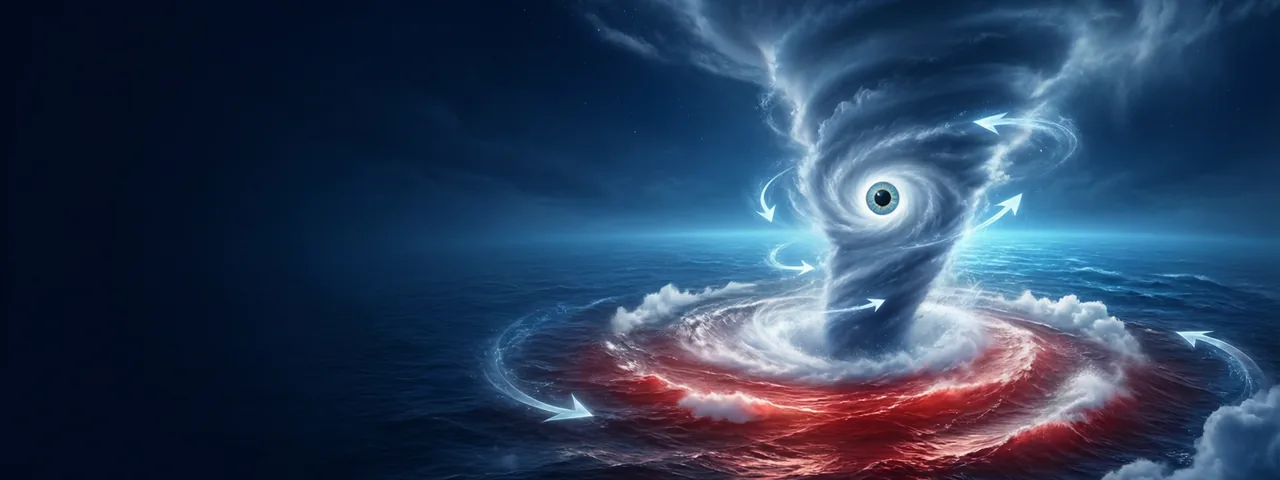
Now imagine air flowing in towards a low-pressure centre. In the north, every parcel is turned to its right, so instead of reaching the centre it curves round it. The whole system circulates counterclockwise (viewed from above) around a low in the Northern Hemisphere, and clockwise in the Southern Hemisphere. Friction near the surface lets some air still spiral in, which keeps the storm fed.
Near the equator the effect fades away because f → 0. Tropical cyclones almost never form within about 5° of latitude (roughly 500 km) of the equator, because there is not enough spin to organise the winds.
A low-pressure system in the Southern Hemisphere rotates...
Why do tropical cyclones almost never form right on the equator?
Does the Coriolis effect decide which way water swirls down a bathtub drain?
What is the Coriolis parameter at 45° latitude, about?