Where it balances
Weight and the centre of gravity
Teaching this? Open projector mode
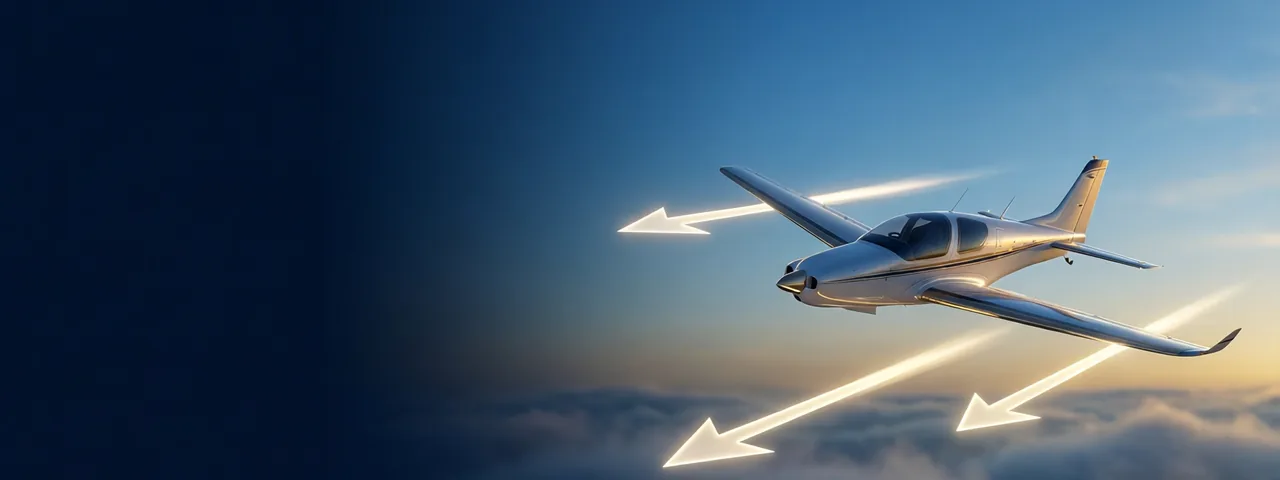
Weight is spread through every part of an aircraft, but we draw it as one arrow. It acts at the centre of gravity (CG), the point where the whole aircraft would balance on a pin. The wing's lift is also spread over the whole wing. We draw it as one arrow at the wing's centre of pressure. For our purposes, treat that as a point about a quarter of the way back from the leading edge, the aerodynamic centre.
If the two arrows do not pass through the same point, they create a moment (a turning effect): moment = force × distance. The toy plane has its wing lift 0.10 m behind the CG. The nose-down moment is 9,810 N × 0.10 m = 981 N·m. Something must cancel that, or the nose would pitch down.
The tail is a small wing used as a lever. The horizontal tail sits a long way behind the CG, say 5 m. It pushes down with a small force F, and F × 5 m must equal 981 N·m, so F ≈ 196 N, only 2 percent of the weight. A small force on a long lever balances a big force on a short one. That is why even a modest tail does the job. (Many aircraft have a nose-down moment from the wing and a small downward load on the tail in normal flight. Some designs use a tail ahead of the wing or no tail at all.)
Where the CG is matters. The CG moves when the load moves: passengers, baggage, fuel being burned. As an example, put a 50 kg bag 2 m behind the CG of the toy 1,000 kg plane. The new CG is 50 × 2 / 1,050 ≈ 0.095 m (about 10 cm) further back. Now the wing lift is only 0.005 m behind the CG and the nose-down moment is almost gone.
What goes wrong at the edges.
- CG too far forward: the nose is heavy. The tail must push down hard, which costs drag, and there may not be enough elevator power left to raise the nose for landing.
- CG too far back: the aircraft loses stability. Past a limit called the neutral point (the position that behaves like the aircraft's overall aerodynamic centre), any small nose-up gust makes the nose want to rise further instead of coming back. The next worlds explain this with stability (World 2) and a paper plane you can balance on a finger (World 3).
That is why every aircraft has a weight and balance calculation and a published CG range: the load has to stay inside it. Loading cargo or passengers is not a matter of "just fit it in".
The centre of gravity of an aircraft moves backwards because of the way it was loaded. What is the main danger?
What does the horizontal tail do in balance terms?
Why does the loading of cargo matter?
A 50 kg bag is placed 2 m behind the CG of a 1,000 kg aircraft. About how far back does the CG move?