Four forces in balance
Lift, weight, thrust and drag
Teaching this? Open projector mode
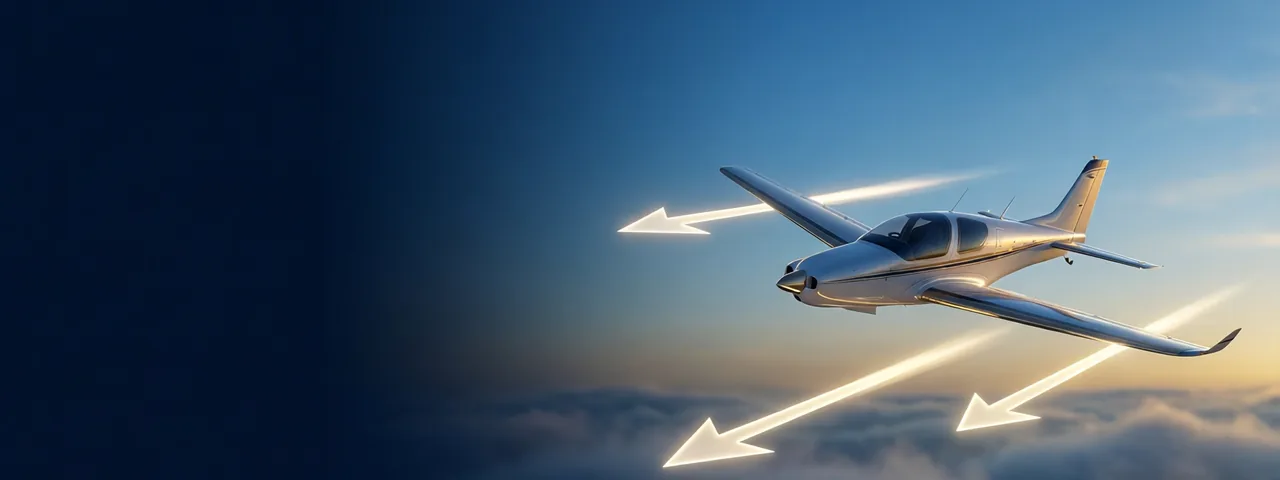
Every aircraft, from a paper plane to an airliner, is pushed and pulled by the same four forces. A force is measured in newtons (N), and each one is drawn as an arrow.
- Weight (W) pulls the aircraft down towards the centre of the Earth. It is mass times gravity: W = m × g, with g = 9.81 m/s². A 1,000 kg light plane weighs 9,810 N.
- Lift (L) is the force of the air on the wing at right angles to the airflow. In level flight that means upwards.
- Thrust (T) is the push forward from a propeller or a jet engine.
- Drag (D) is the air resisting the motion. It points backwards, along the airflow.
Lift and drag both come from the air pushing on the aircraft. Weight is the Earth pulling. Thrust comes from the engine. Notice that the engine does not hold the plane up. That is the job of the wing.
Balance means steady flight. Newton's first law says an object keeps moving at constant velocity when the forces on it add up to zero. So an aircraft flying level at a steady speed has:
- L = W (up equals down), and
- T = D (forward equals backward).
Nothing is "left over", so nothing changes. If the forces are not equal, Newton's second law takes over: net force = mass × acceleration. Suppose the toy 1,000 kg plane has thrust 200 N bigger than drag. The net force forwards is 200 N, so a = 200 / 1,000 = 0.2 m/s². The plane speeds up, slowly at first, until the rising drag catches up with the thrust and the forces balance again at a higher speed.
The same logic works up and down. If lift is larger than weight the aircraft is pushed upwards and its flight path curves up. If lift is smaller it curves down.
How big are the numbers? The ratio of lift to drag, L/D, tells you how cheaply a wing carries its weight. In steady level flight L = W and T = D, so T = W / (L/D). The toy light plane in this course has a best L/D of about 12.5 (you will see why in lesson 3). Then:
T = D = 9,810 N / 12.5 ≈ 785 N, only about 8 percent of the weight. A plane is a very efficient way to move weight, because the wing carries it. A helicopter in the hover has no such help: its rotor must produce a thrust equal to its whole weight (World 5).
Climbing and descending. In a steady climb the flight path is tilted by an angle γ. Now the engine must also pull the plane uphill against part of its weight: T = D + W sin γ. For a 5° climb, W sin 5° ≈ 9,810 × 0.087 ≈ 855 N of extra thrust. In a glide with the engine off, the same part of the weight pulls the plane forward instead. You will use that in World 6.
This course is education. It explains the physics of flight so that aircraft make sense. It is not flight training and it is not operating instructions for any aircraft. Real pilots learn from certified instructors and from the manual of the aircraft they fly. The numbers use a simplified toy aircraft, so they will not match any real type exactly.
A plane flies level at a steady speed. How do lift and weight compare?
In level flight the thrust is increased so that it is larger than the drag, and nothing else changes. What happens first?
Why is "a plane does not fall because it is flying" a poor explanation?
A 1,000 kg plane climbs at a steady 5° angle. Compared with level flight, what does the engine have to provide?