Gluten: the stretchy net
Why dough holds its gas
Teaching this? Open projector mode
Gas bubbles alone do not make bread rise. Imagine yeast making CO₂ in a bowl of thin pancake batter: the gas just escapes. Bread dough holds its gas because it contains a stretchy, elastic net of gluten.
Gluten is not one molecule. It is a family of proteins in wheat flour, and two groups matter most:
- Glutenins are long protein chains that join to each other to form very big, cross-linked networks. They make dough elastic: it springs back.
- Gliadins are smaller, single chains. They act like a lubricant, making dough extensible: it stretches without snapping.
Wheat gives dough both properties at once, which is why wheat bread is so airy. Barley and rye have related proteins.
Dry flour has no gluten net. The proteins only form it when two things happen:
1. Water is added. The proteins soak it up, loosen and can move.
2. Work is done: kneading, folding, or just a long wait. The chains line up and join. Some of the links are disulfide bonds (a bond between two sulfur atoms on neighbouring chains), which are strong and can reshuffle while the dough rests.
Salt tightens the net a little. Too much kneading with a machine can start to break it, so a dough becomes slack and sticky.
Bakers write recipes as baker’s percentages: every ingredient is compared with the flour mass. If 500 g of flour is mixed with 300 g of water, the hydration is 300 ÷ 500 = 60 percent. Many bread doughs are between about 60 and 75 percent. Wetter dough gives a more open crumb and is harder to handle.
The kind of flour matters. Bread flour (strong flour) has a protein content of roughly 11 to 14 percent, so it forms a strong net. Cake or pastry flour has roughly 7 to 9 percent, so it gives a soft, tender crumb. All-purpose flour is in between.
How do bakers check that the net is ready? With the windowpane test: pinch off a small piece of dough and stretch it gently. A well-kneaded dough can be pulled into a thin, almost see-through sheet without tearing. When the sheet tears at once, the net needs more work.
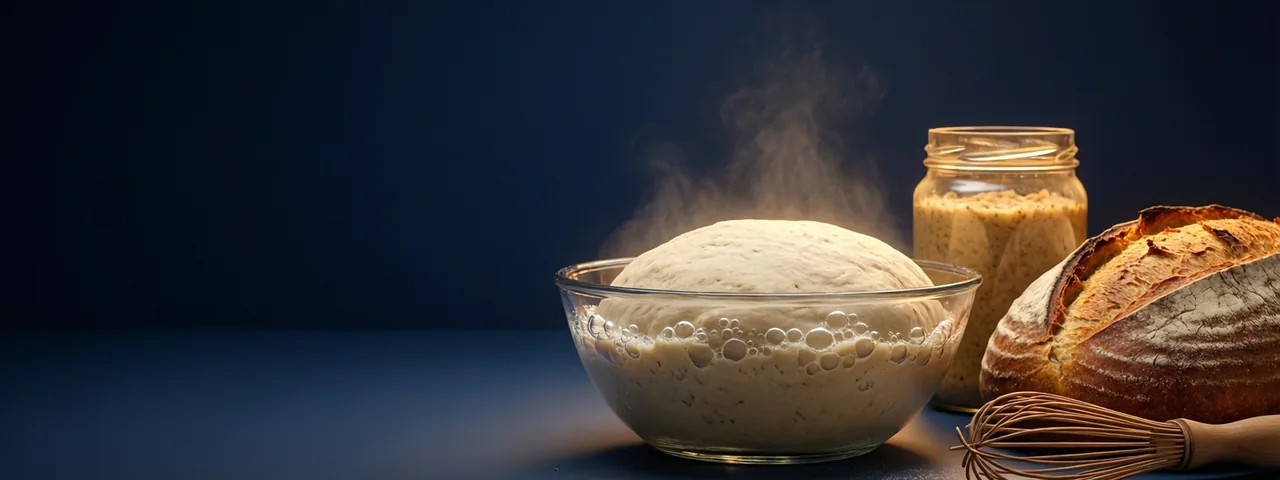
When the net is ready, the CO₂ from the yeast is trapped in thousands of small pockets, each held by a thin film of stretched gluten. That is the crumb you see when you slice bread.
What does kneading do to dough?
300 g of water is mixed with 500 g of flour. What is the hydration?
Which flour has the most gluten-forming protein?
A baker stretches a bit of dough thin and it tears at once. What does that suggest?