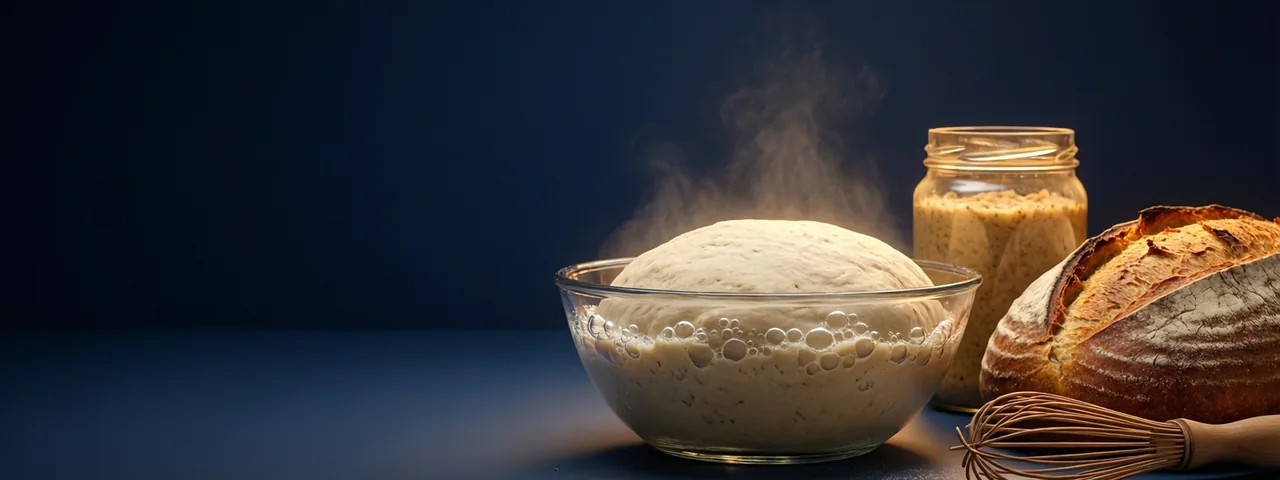
Yeast eats sugar
Fermentation makes the bubbles
Teaching this? Open projector mode
Bread dough starts as a thick, heavy paste. A few hours later it has doubled in size and is full of holes. Something inside is making gas.
That something is baker’s yeast, a single-celled fungus called Saccharomyces cerevisiae. Each cell is only about 5 to 10 micrometres wide, so a pinch of dry yeast holds billions of them. Yeast is not a plant and not a bacterium. Fungi, like mushrooms and moulds, are their own kingdom of life.
Yeast cells need food. In dough they feed on sugars: a little sugar that is already in flour, any sugar the baker adds, and maltose, which the enzymes in flour make by chopping starch into smaller pieces. (The Cell Lab explains enzymes. Here, all you need to know is that yeast eats sugar.)
With little oxygen around, yeast gets energy by fermentation. For glucose, the balanced equation is:
C₆H₁₂O₆ → 2 C₂H₅OH + 2 CO₂
One glucose molecule becomes two molecules of ethanol and two molecules of carbon dioxide gas. Check the masses: 180 g of glucose gives about 92 g of ethanol and 88 g of CO₂. Almost half of the sugar’s mass leaves as gas.
The carbon dioxide is what raises the dough. It collects in tiny bubbles that stretch the dough, just as a balloon stretches when you blow into it. At room conditions, one gram of glucose that is fermented makes about 0.27 litres of CO₂ (1 g ÷ 180 g/mol ≈ 5.6 mmol, doubled, times about 24.5 L/mol).
The ethanol and many other small flavour molecules dissolve into the dough and give bread its yeasty smell. During baking most of the ethanol leaves as vapour. This lab is about baking only: it never makes drinks.
Yeast is alive, so it is very sensitive to temperature:
- In the cold (a fridge is about 4 °C) yeast works very slowly. Bakers use this on purpose: a dough left in the fridge overnight rises slowly and develops flavour.
- Between about 30 and 38 °C yeast is most active, which is why dough rises quickly in a warm kitchen.
- Above about 55 to 60 °C yeast cells die. The exact figure depends on the strain and on how long the heat lasts. Dead yeast makes no more gas.
As a rough rule many chemical reactions run about twice as fast for every 10 °C warmer, until the living cell is damaged by heat. That is why the rise speeds up smoothly and then suddenly stops.
Which gas makes bubbles in rising dough?
What happens to yeast in 70 °C water?
Why can dough rise slowly overnight in a refrigerator?
What kind of living thing is baker’s yeast?