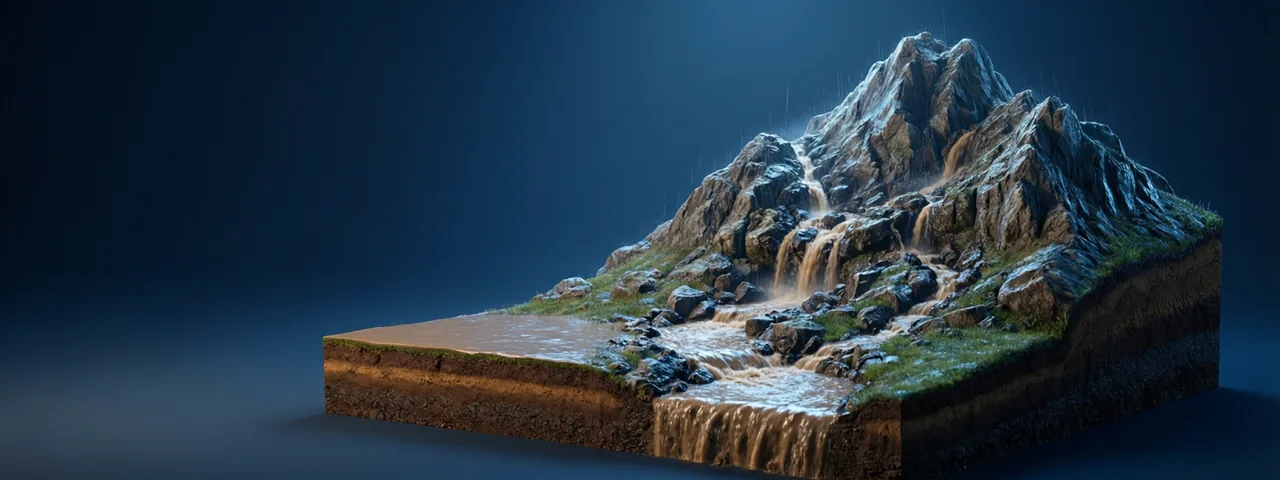
Rock to rubble: weathering
How solid rock breaks down where it sits
Teaching this? Open projector mode
Look at an old stone wall, a worn gravestone or a crumbling cliff. Hard rock does not stay hard forever. Rain, ice, air and living things slowly turn it into smaller pieces. This is weathering, and it is the first step in the story of every landscape: it makes the loose material that rivers, glaciers and wind can later move.
The key idea of this lesson is one sentence: weathering breaks rock down where it sits; erosion carries the pieces away. We will meet erosion in a few lessons. For now, remember that weathering does not need any movement at all.
Physical (mechanical) weathering breaks rock into smaller pieces without changing what the rock is made of.
- Freeze-thaw (frost wedging). Water seeps into a crack. When it freezes it expands: liquid water turns into ice that takes up about 9 percent more volume. Check it with densities: ice is about 917 kg/m³ and liquid water about 1000 kg/m³, so 1 kg of water (1000 cm³) becomes
1000 ÷ 917 ≈ 1.09times as much, about 1090 cm³ of ice. In the crack, that extra volume pushes on the walls. Day after day of freezing and thawing, the crack widens and pieces fall off. Research shows that ice also grows by drawing water towards it inside the rock, so the simple 9 percent picture is the textbook start, not the whole story. - Heating and cooling. Rock that heats by day and cools by night expands and contracts a little. In deserts this can help crack rock, although experts still debate how big the effect is on its own.
- Unloading. When rock that was buried is exposed, it can expand and peel off in sheets.
- Salt crystals. Salty water dries inside pores and the growing crystals push the grains apart. This is common on coasts and in dry places.
Chemical weathering changes the minerals themselves.
- Carbonation. Rain absorbs a little carbon dioxide from the air and from soil, forming a weak acid (carbonic acid). Natural rain is slightly acidic, with a pH of about 5.6. Limestone, which is calcium carbonate, dissolves in it. You will see the chemistry in the cave world.
- Oxidation. Iron-bearing minerals react with oxygen and water and turn rusty red or brown, which weakens the rock.
- Hydrolysis. Water reacts with feldspar, a common mineral in granite, and turns it into soft clay minerals. Granite in warm, wet climates can rot to a crumbly soil many metres deep.
- Acid rain. Pollution from burning fuels (sulfur and nitrogen compounds) makes rain more acidic than natural rain and speeds up damage to limestone and marble buildings and statues.
Biological weathering is done by living things: tree roots wedge into cracks and widen them, lichens and mosses release weak acids, and burrowing animals open up the soil and rock.
What speeds weathering up? Three things matter most.
- Climate. Chemical weathering is fastest where it is warm and wet. Freeze-thaw is fastest where temperatures cross 0 °C often.
- Rock type. Limestone dissolves; quartz-rich sandstone is slow. Some rocks have more cracks.
- Surface area. Cut a cube of side L into smaller cubes and the total surface grows. Slice each edge into 10 parts and you get 1000 small cubes with 10 times the total surface area (6L² becomes 60L²). More surface means more places for water and air to attack. That is why cracked rock breaks down faster, and why it speeds up as it breaks.
What happens to the products? The broken pieces, plus the dissolved ions, are called sediment when they are moved. Pieces left in place, mixed with dead plant material, become soil. So weathering gives us two gifts: sediment for rivers to carry and soil for plants to grow in.
What is the main difference between weathering and erosion?
Why can freeze-thaw crack a rock?
Which of these is an example of chemical weathering?
A cube of rock is broken into 1000 smaller cubes. What happens to the total surface area where weathering can attack?