AP and IB Biology: Cells and Genetics Study Guide
Plan your revision of cell structure and Mendelian genetics for AP and IB Biology, with free interactive lessons, common pitfalls and a simple weekly study plan.
Cells and genetics sit at the heart of almost every upper-secondary biology course. They are also topics where a picture beats a paragraph: once you have crossed two pea plants on screen and watched a ratio appear, a Punnett square stops being a chore. This guide organises both topics around free interactive lessons and a realistic study plan.
What these courses commonly cover
AP Biology and IB Biology differ in structure and emphasis, so use your own syllabus as the final word. Topics commonly covered in both include:
- cell structure and function, membranes and transport
- energy in cells, such as respiration and photosynthesis
- DNA, protein synthesis and the cell cycle
- inheritance, from Mendelian crosses to more complex patterns
- evolution and ecology
This guide focuses on two linked pieces: how cells are organised, and how traits pass from one generation to the next.
AP is a registered trademark of the College Board, which is not affiliated with Novareka. IB is a registered trademark of the International Baccalaureate Organization, which is not affiliated with Novareka.
Cell structure: function follows form
The most reliable way to learn organelles is to attach each one to a job and a reason. Mitochondria release usable energy. The nucleus holds the instructions. Ribosomes build proteins. The membrane controls what comes in and out.
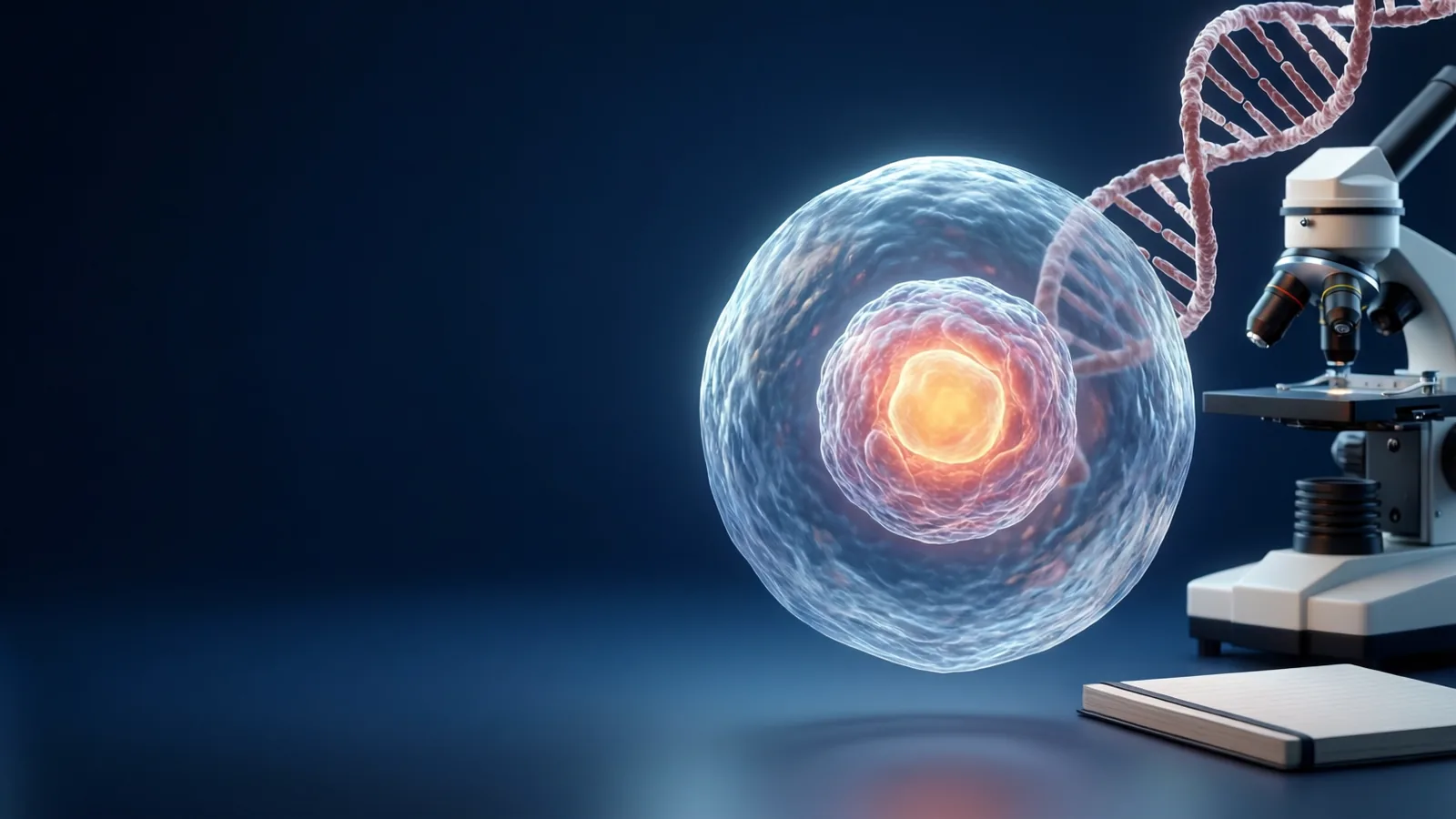
Plant and animal cells share most of this, but plant cells add a cell wall, chloroplasts and a large central vacuole. The comparison lesson Animal and plant cells is a quick way to lock in those differences, and Inside the cell in the anatomy lab shows the working parts at a larger scale.
Exam tip: when asked "why would a cell with many mitochondria be found here?", reason from function. High energy demand means more mitochondria. The same logic works for ribosomes in cells that make a lot of protein.
Transport
Know the difference between passive movement (diffusion, osmosis) and active transport, which needs energy. The osmosis lesson in the cell lab, Osmosis, is well suited to the usual question about what happens to a cell in a more dilute or more concentrated solution.
Mendel: traits, alleles and what you can see
Genetics has a lot of vocabulary, and most lost marks come from using it loosely. Hold on to these distinctions:
- A gene is a unit of inheritance; an allele is one version of it.
- Genotype is the allele combination; phenotype is the observable result.
- Dominant alleles show in the phenotype when present; recessive ones show only when two copies are present.
- Homozygous means two identical alleles; heterozygous means two different ones.
The free lessons Dominant & recessive and Genotype vs phenotype practise exactly this.
Punnett squares and ratios
A Punnett square is a bookkeeping tool: list the possible gametes from each parent, combine them, and count. In a cross between two heterozygotes for a simple dominant-recessive trait, the genotype ratio is 1 : 2 : 1 and the phenotype ratio is 3 : 1.
Two cautions:
- A ratio is a probability for each offspring, not a guarantee for a small family.
- Real data rarely match the ratio exactly. Small samples wander, which is why examiners ask you to comment on whether results are consistent with a prediction.
The Punnett square and Reading ratios turn this into a quick routine. Remember that the lab is a simplified teaching model of single-gene inheritance, while many real traits involve several genes and the environment.
Common pitfalls
- Mixing up genotype and phenotype in a written answer.
- Saying dominant means "most common" or "better". It only describes how the allele behaves when paired.
- Forgetting that each parent gives one allele per gene.
- Describing organelles by name only, with no function.
- Treating the 3 : 1 ratio as exact.
If you find yourself making one of these, write it on a card and revisit it before each practice session.
A simple weekly study plan
- Early week: one lesson on cells, then label a blank diagram from memory.
- Midweek: one genetics lesson, then three Punnett squares by hand, including one with a heterozygous parent.
- Weekend: a short practice exam, mark it, and log every miss under "vocabulary", "method" or "careless".
Each lab has its own practice exam, for example the Genetics practice exam. After a few weeks you will see which of the three categories costs you most, and that tells you where to spend time.
How to explore this in the lab
A sensible order through the free lessons:
- What is a trait? and Dominant & recessive
- Genotype vs phenotype
- The monohybrid cross, then The Punnett square
- Reading ratios
- Animal and plant cells to connect genes to the cells that use them
Try to predict each cross before running it. That small habit builds the intuition exams test.
- Learn each organelle as a job, then reason from function.
- Keep genotype and phenotype strictly separate in written answers.
- A 3 : 1 ratio is a probability, not a guarantee.
- Log every practice miss as vocabulary, method or careless.
Dominant & recessive
Which allele you see. About 5 minutes. Free, no account, runs in your browser.
More free lessons from this guide
Simulations on Novareka are teaching models, simplified on purpose. They show how an idea behaves; they are not a substitute for professional, medical or engineering advice.
Labs in this guide
 Live
Live Live
LiveKeep reading
All guides → Explainer
 Explainer
 Exam prep