Why Day Length and Shadows Change: Earth, Sun and Shadows
How a spinning Earth gives day and night, why daylight hours depend on where you stand, and how Sun height sets shadow length so a stick can tell the time.
The Sun seems to cross the sky every day, shadows stretch out in the evening, and summer days are longer than winter ones. All of these everyday things come from one fact: Earth is a spinning ball lit from one side. This guide connects the pieces.
Day and night come from spinning
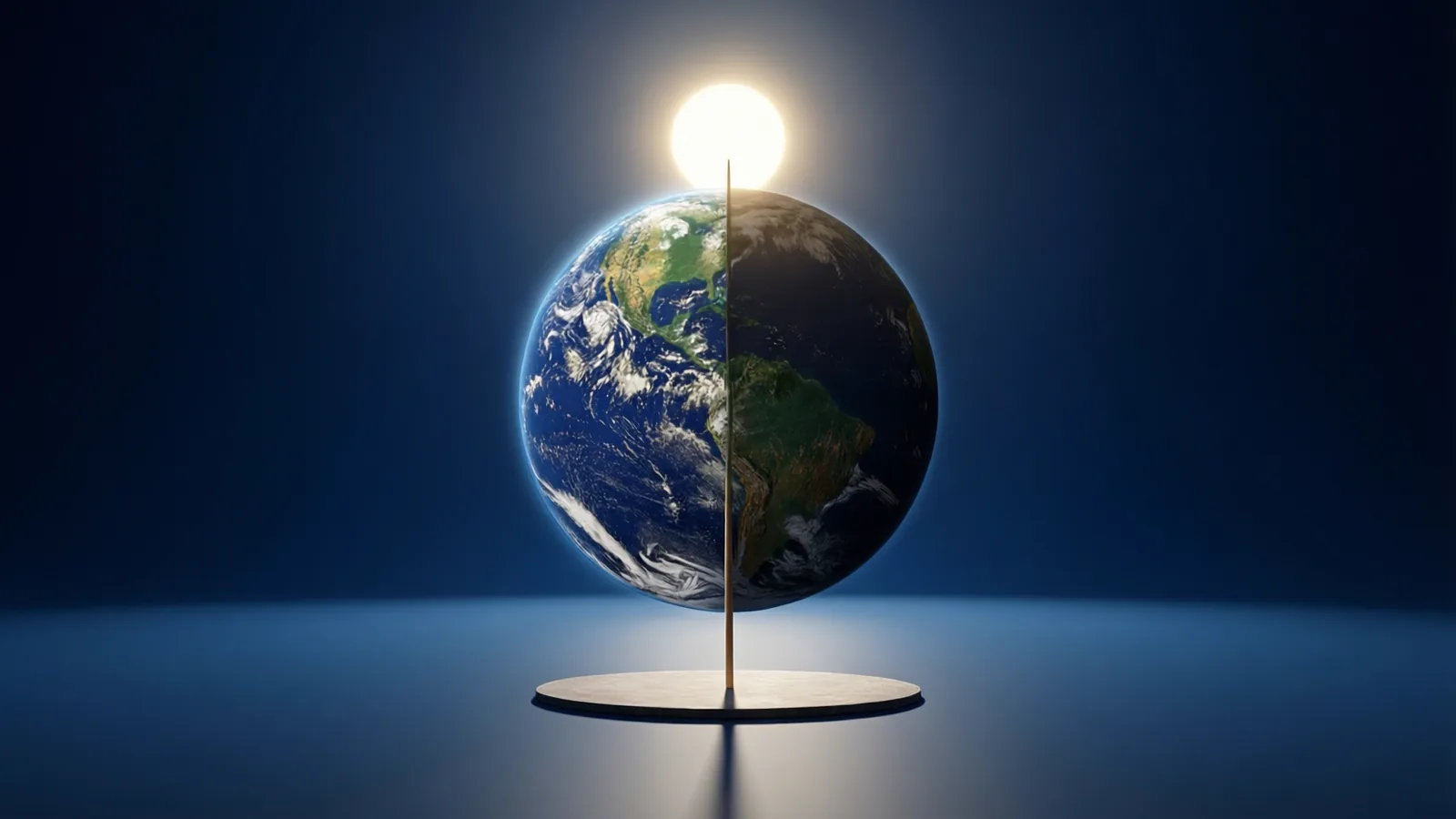
The Sun does not circle the Earth each day. Earth turns on its axis, completing one turn about every 24 hours. Whichever side of the planet faces the Sun is in daytime, and the opposite side is in night.
The boundary between them is the terminator. As Earth rotates, your town is carried toward that line, through it and out the other side. Crossing into the light is sunrise; crossing back into the dark is sunset.
Earth turns toward the east, which is why the Sun appears to rise in the east and set in the west.
Why daylight is not always 12 hours
A full day is 24 hours, but the amount of daylight in it changes with place and date. Picture a pin on the globe. As Earth spins, the pin traces a circle of constant latitude. Some of that circle lies in sunlight, and some lies in shadow. The longer the sunlit part, the longer the day.
Because Earth's axis is tilted, the terminator does not run neatly pole to pole in most of the year. It cuts circles of latitude unevenly. Near the equator, those circles are split almost in half all year, so daylight is close to 12 hours every day. Nearer the poles the split gets very uneven: long days in one season, short ones in the other, and near the poles themselves, stretches of continuous light or dark.
The same date can therefore give very different daylight to two places at different latitudes.
Shadows and the height of the Sun
A shadow is ground that sunlight cannot reach, because an object sits in the way. Take a vertical stick on flat ground: the single ray skimming past its upper end marks where the shadow stops.
That makes the geometry simple. The shadow length depends only on the stick's height and how high the Sun is above the horizon:
shadow length = stick height ÷ tan(Sun elevation)
- Sun high in the sky: the shadow is short.
- Sun low near the horizon: the shadow is long.
- Sun at 45°: the shadow is as long as the stick is tall.
A taller stick scales everything up in proportion, but the pattern stays the same. This is also why your own shadow stretches long in the morning and evening and shrinks around midday.
The Sun’s path and the shadow clock
For a given place and date, the Sun follows a fixed arc across the sky. It climbs through the morning, reaches its highest point at solar noon, and sinks through the afternoon. The shadow follows it exactly, pointing away from the Sun and changing length as the Sun rises and falls.
That is the idea behind a sundial or shadow clock. Mark where the shadow tip falls at different times and you can read the time from the direction of a shadow. Two details matter:
- the arc is different in each season, so a clock must be set up for the right date and latitude, and
- solar time and the time on your phone do not match exactly, because clocks are set for a whole region.
Even a simple stick in the ground tells you a lot: the shortest shadow of the day marks solar noon, and outside the tropics it points toward true north or true south, depending on your hemisphere.
Common misconceptions
- "It is dark at night because the Sun moves behind the Moon." Night is simply the side of Earth facing away from the Sun.
- "The Sun is directly overhead at noon everywhere." Only places in the tropics can ever have it overhead, and only on some days.
- "Shadows always point north." They point away from the Sun, so their direction changes through the day.
- "Seasons exist because Earth is closer to the Sun in summer." Tilt, not distance, causes the seasons, and day length is a big part of the story.
- "Every day has exactly 12 hours of daylight." Only near the equator is that roughly true.
How to explore this in the lab
The Sun, Earth & Moon lab lets you spin the planet, move the pin and drag a lamp or the real Sun around a stick. A path through the free first world:
- Begin with A spinning Earth and watch the terminator sweep over the pin.
- Compare places and dates in How long is a day?.
- Measure the geometry in Sun height and shadow length.
- Put it all together with The Sun's path and the shadow clock.
The simulation is a simplified teaching model: it ignores atmosphere, hills and the small wobbles in Earth's motion, so sunrise and sunset times come out slightly tidier than real life. The core geometry matches what you can check yourself with a stick on a sunny day.
- Day and night happen because Earth spins; the lit half is day.
- Daylight hours depend on latitude and date, not just the 24-hour day.
- Shadow length = stick height ÷ tan(Sun elevation): a low Sun makes a long shadow.
- The shortest shadow of the day marks solar noon, which is how a shadow clock works.
A spinning Earth
Why the Sun rises and sets. About 6 minutes. Free, no account, runs in your browser.
More free lessons from this guide
Simulations on Novareka are teaching models, simplified on purpose. They show how an idea behaves; they are not a substitute for professional, medical or engineering advice.
Labs in this guide
 Live
Live Live
Live Live
LiveKeep reading
All guides → Parents
 Parents
 Parents