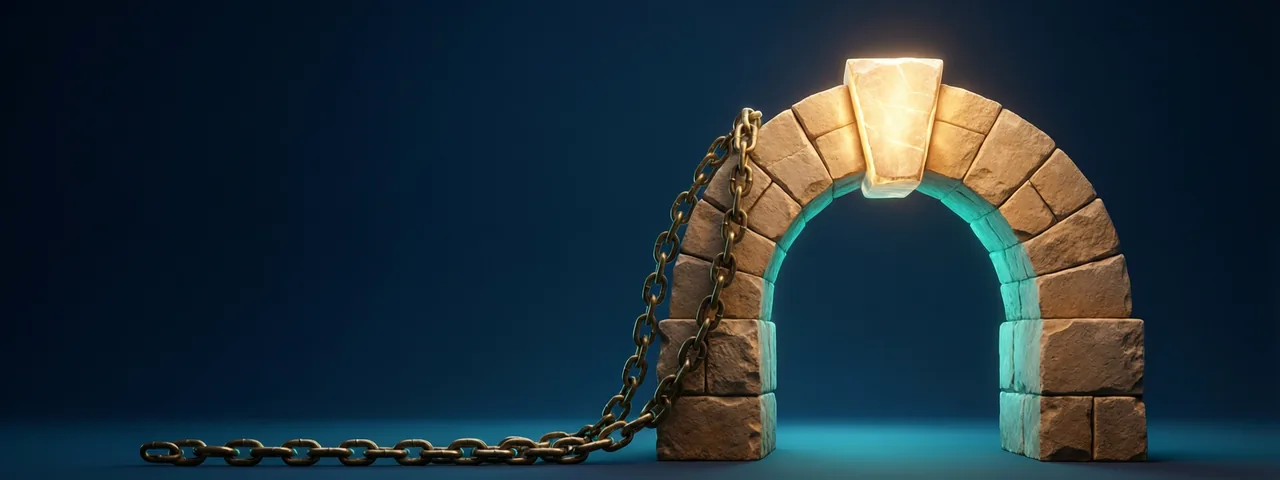
Building with blocks
Keystone and centering
Teaching this? Open projector mode
A stone arch is made of wedge-shaped blocks called voussoirs (say “voo-SWAHR”). They are laid on a temporary wooden frame called the centering (or falsework), which holds each stone in the right place. The last stone, at the crown, is the keystone. Only when it is in place, and the centering is removed, does the arch take its load. Before that moment, the stones are just a pile that would fall if the frame vanished.
The keystone has a famous reputation, but it is not special in the way people think. Every voussoir carries the thrust. The keystone closes the ring and lets the compression start working, but it does not hold the arch up by itself. In many arches the keystone is actually among the least-loaded stones.
How can stone with no glue stand up at all? Stone does not like being pulled, and dry joints cannot pull at all. So the arch must stay in compression everywhere. The engineer’s tool is the line of thrust: imagine the path that the force takes through the stones, from the top, through each joint, down to the foundation. At each joint the force acts at one point.
- If the line of thrust is at the middle of a joint, the stone is evenly squeezed.
- If it moves toward the edge, the pressure bunches up at that edge and the other edge unloads.
- If it stays within the middle third of the stone’s thickness, the whole joint is still squeezed: no tension anywhere. For a rectangular section of thickness
t, a squeezeNacting at distanceefrom the centre gives edge pressures of(N ÷ t) · (1 ± 6e ÷ t), and the lighter edge goes to zero exactly ate = t ÷ 6, which is the edge of the middle third. - If the line leaves the stone, the joint opens and the stones begin to hinge.
A masonry arch typically fails not by crushing, but by turning into a mechanism. When the line of thrust touches the edge of the stone at a joint, that joint acts like a hinge. Four hinges in the right places turn a semicircular arch into a moving linkage, and it folds. This is the four-hinge mechanism.
The British engineer Jacques Heyman turned this into a beautifully simple rule in the 1960s (his book The Stone Skeleton). Assume the stones do not slide, do not crush and cannot be pulled apart. Then if you can find any line of thrust that fits inside the arch for the loads, the arch will stand. You do not have to know what the arch really does; you only have to show that a safe path exists. A thicker arch has more room for the line, so it is safer. A semicircular arch of uniform thickness that carries only its own weight needs a thickness of at least roughly a tenth of its radius; a heavy point load or a settling support asks for more.
That is why a stone arch tolerates small cracks and movements: it can find another line of thrust. It is also why a heavy load placed in the wrong spot, such as a heavy lorry on an old bridge, can start a hinge that a normal load never would.
Why is centering needed while an arch is built?
What does it mean when the line of thrust stays inside the middle third of the arch ring?
A masonry arch collapses by forming hinges. How many hinges turn a typical arch into a mechanism?