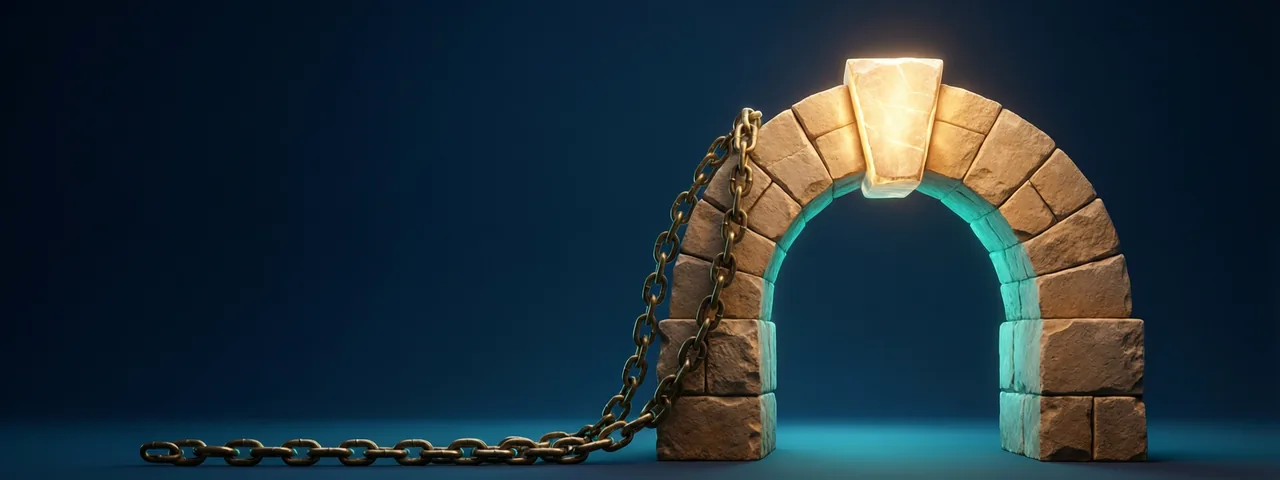
Squeeze or stretch?
Compression and tension
Teaching this? Open projector mode
Every part of a structure is being pushed or pulled by its neighbours. Engineers sort those internal forces into a few kinds:
- Compression: the material is squeezed. A column under a roof, a stack of books under a hand.
- Tension: the material is stretched. A rope holding a lamp, a bridge cable, a stretched rubber band.
- Shear: layers of the material try to slide past each other, like cutting paper with scissors.
- Bending: a beam sags, so its top edge is squeezed and its bottom edge is stretched.
A force alone does not tell you whether a part will survive. What matters is the force spread over the area that carries it. That is stress: stress = force ÷ area, measured in pascals (Pa), or megapascals (MPa, millions of pascals). A 1 kN load (about the weight of a 100 kg mass) hanging from a rod with a cross-section of 100 mm² gives 1 000 N ÷ 0.0001 m² = 10 MPa.
Materials are not equally good at both jobs. Stone, brick and concrete are strong in compression and weak in tension. As a rough guide, their tensile strength is about a tenth of their compressive strength, and often less. Pull on a stone beam and it cracks long before a squeezed stone block of the same size would. Steel and rope are the opposite kind of friend: steel is strong both ways, and a rope or cable is excellent in tension but useless in compression, because a rope simply goes slack when you push it.
There is one more catch. A slender part that is squeezed does not crush first; it buckles, bowing sideways like a ruler pressed end to end. That is why stone columns are thick and why steel compression members are made as tubes or deep sections rather than thin rods.
The lesson for designers is that the shape of a structure decides which internal force it uses. You can often choose the shape so that a weak-in-tension material only ever feels compression. That is exactly what an arch does. And when you have a strong tension material, a cable is the lightest possible way to carry load across a gap.
Which description fits stone and concrete best?
A bridge needs a long, light member that only ever carries a pull. Which is the best choice?
A 2 kN load hangs from a rod with a cross-section of 200 mm². What is the stress in the rod?