Hang a chain, flip it
The catenary arch
Teaching this? Open projector mode
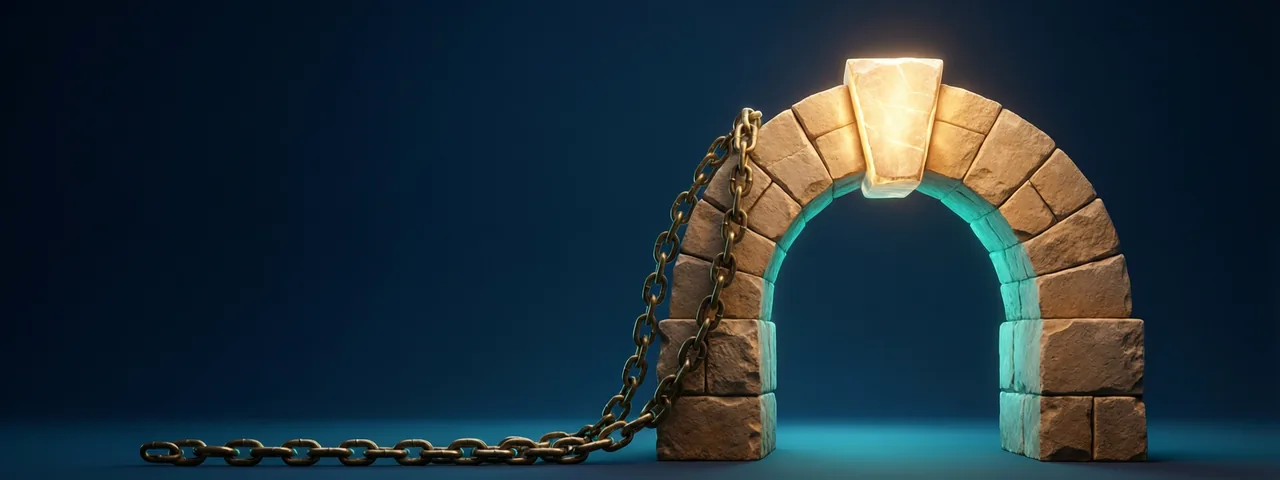
Hang a loose chain from two nails. It sags into a smooth curve. Because a chain is flexible, it can only pull along its own length; it cannot push or bend. So a hanging chain is in pure tension. Its shape is not random: each link settles exactly where the pull on it balances the weight below. The shape is called the catenary, from the Latin catena, “chain”.
The equation of the curve is y = a · cosh(x ÷ a), where cosh is the hyperbolic cosine and a is a length that depends on how tight you pull the chain (a = H ÷ w, the horizontal pull divided by the weight per metre). A tighter chain has a bigger a and a flatter curve. Galileo thought the curve was a parabola; in the early 1690s Huygens, Leibniz and Johann Bernoulli showed that it is not.
Now the clever part. Flip the picture upside down. Every force reverses: where each link was pulled, the matching block is now pushed. The English scientist Robert Hooke put this in a famous Latin anagram in 1675, which he explained in 1705 as roughly “as hangs the flexible line, so but inverted will stand the rigid arch.” An arch cut to the inverted catenary carries its own weight in pure compression, with no part trying to bend or pull apart. That is the dream for stone, which is weak in tension.
The Catalan architect Antoni Gaudí used this idea in a very hands-on way. He hung small sacks of lead shot from a web of strings, let the string net find its own shape, and then looked at it in a mirror to see the stone structure. His hanging model for the church of the Colònia Güell is the best-known example, and he used hanging studies for the Sagrada Família too. The St Louis Gateway Arch (1965, 192 m tall) follows the same idea: its shape is a flattened weighted catenary, thicker at the base than at the top.
Catenary or parabola? Both are smooth U-shapes, and near the bottom they look almost identical. They answer different loads:
- The load is spread along the curve (a chain’s own weight): catenary.
- The load is spread evenly along the horizontal (the deck of a suspension bridge, hanging from many equal hangers): parabola,
y = 4f · x(L − x) ÷ L², wherefis the sag andLthe span.
For a shallow sag the two differ by only a small amount, which is why the main cable of a suspension bridge is called a parabola even though the cable’s own weight adds a slight catenary effect. For a deep sag the difference is large. The general rule: the ideal arch shape follows the loads. Change the loads and the best shape changes with them.
A freely hanging chain carries its own weight. What internal force does it have?
You flip the picture of a hanging chain upside down. What does an arch of that shape carry under its own weight?
Which load pattern gives a parabola rather than a catenary?