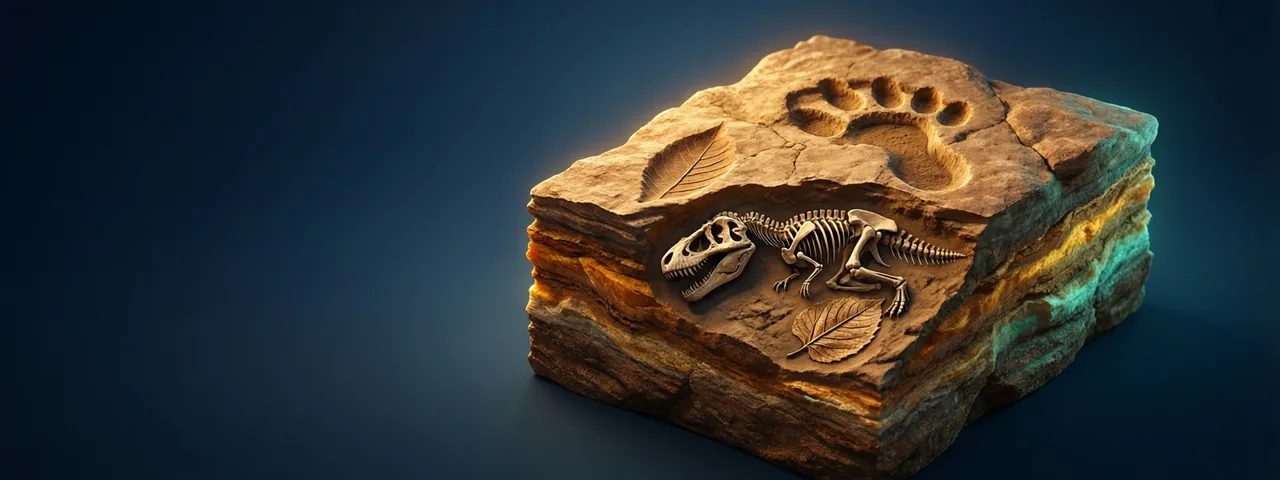
From carcass to fossil
The race between rotting and burial
Teaching this? Open projector mode
Taphonomy is the study of what happens to a living thing between its death and its discovery. After an animal dies, scavengers feed on it, bacteria break down the soft tissue, and weather cracks the bones. Left on the surface, a skeleton can fall apart within years or decades.
Whether a fossil forms is a race between destruction and burial. If sediment (mud, sand or ash) covers the body fast, the bones are shut away from scavengers, sunlight and most of the oxygen. Settings where that happens are:
- a river delta or flooded plain, where a flood drops a blanket of mud
- a volcanic ash fall
- a sandstorm or a collapsing sand dune
- a landslide, or the bottom of a lake or sea
A famous example from the Gobi Desert in Mongolia is the “fighting dinosaurs” specimen: a Velociraptor and a Protoceratops found locked together, buried suddenly, probably by a collapsing dune or a sandstorm.
Places that are bad for fossils include the floor of a forest with acidic soil, which slowly dissolves bone, and open ground that is picked clean by scavengers and then broken by sun and frost.
Now the chemistry. Water seeping through the buried sediment carries dissolved minerals such as silica (the material of quartz), calcite and iron compounds. They crystallise in the empty spaces inside the bone: the tiny pores, the marrow cavity and the canals that once held blood vessels. This is permineralisation. The bone keeps its shape, and often its fine inner structure, but becomes heavier and harder.
Over long times some of the original bone mineral may also dissolve and be replaced by a new mineral, or recrystallise. How much changes depends on the chemistry of the groundwater and on time.
Finally, a fossil has to come back to the surface. Deeply buried sediment is squeezed and cemented into rock. Slow movements of Earth’s crust lift the rock up, and erosion by rivers, wind, rain and ice strips away the layers above. Eventually the fossil is exposed. There is a short window of discovery: once the fossil is exposed, erosion keeps working and will break it up unless someone finds it first. This is why palaeontologists often search eroding hillsides after rain.
Which setting gives a carcass the best chance of fossilising?
What is permineralisation?
How does a buried fossil reach the surface?