What counts as a fossil
Body fossils, trace fossils and the missing majority
Teaching this? Open projector mode
A fossil is the preserved remains or traces of a living thing from the distant past. Scientists usually keep the word for things older than about 10,000 years, roughly the end of the last ice age. That is a convention, not a hard rule.
There are two big kinds:
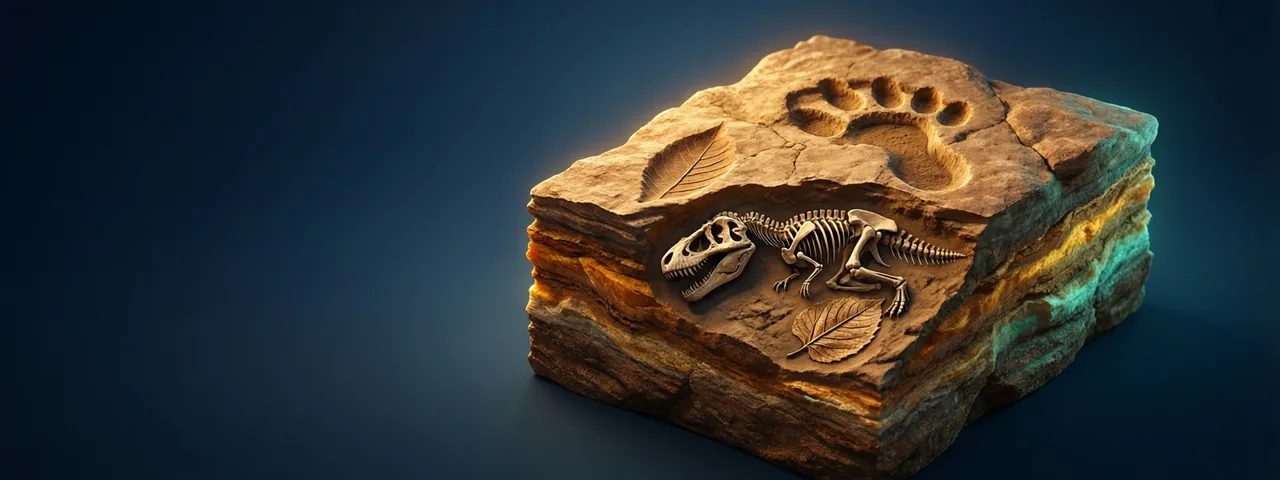
- Body fossils are parts of the living thing itself: bones, teeth, shells, wood, leaves.
- Trace fossils (also called ichnofossils) are evidence of what a living thing did: footprints and trackways, burrows, bite marks, eggs, nests, and coprolites, which are fossilised droppings.
Trace fossils matter because they record behaviour. A bone shows what an animal was shaped like. A trackway shows how it moved. A coprolite shows what it ate. One dinosaur could leave thousands of footprints in its life but only one skeleton, so trace fossils can be far more common than body fossils.
A fossil is not always a piece of bone turned to stone. Common kinds are:
- Original material: an insect trapped in amber (hardened tree resin).
- Permineralised: the tiny spaces in bone or wood fill with minerals (next lesson).
- Mould and cast: a shell dissolves and leaves a hollow in the rock (the mould). If the hollow later fills with minerals, that makes a cast with the shell’s shape.
- Carbon film: a leaf squashed flat leaves a thin dark film of carbon.
The fossil record is incomplete. Most living things never become fossils at all: they are eaten, they rot, or the weather breaks them down. Soft parts such as skin, muscle and feathers usually disappear first, so most fossils are hard parts: bones, teeth and shells.
A few places preserved soft parts because very fine mud buried the animals quickly and the water had no oxygen, which slows rotting. Fossil beds in Liaoning in China and the Solnhofen limestone in Germany are famous for this. They show us feathers, skin and even colour patterns, but they are the exception.
We also only see fossils where the right rocks are exposed at the surface. New dinosaur species are still being named every year, so what we know is a sample of what lived, not a full list.
A dinosaur footprint preserved in mudstone is which kind of fossil?
What is a coprolite?
Why do most animals never become fossils?