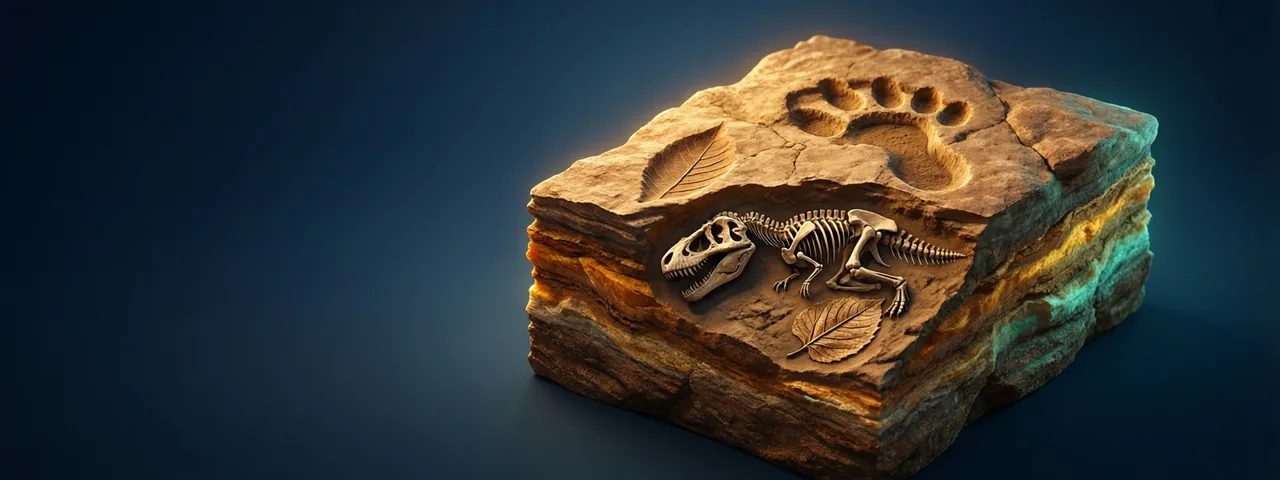
Rock layers: where fossils hide
Sedimentary rock, superposition and index fossils
Teaching this? Open projector mode
You find fossils in sedimentary rock. Sedimentary rock is made of particles such as sand, mud and shell fragments that settle in layers and are later pressed and cemented together. Common kinds are sandstone, mudstone and shale, and limestone. The conditions are gentle enough that a bone is not crushed or melted.
It is very unlikely that you find a fossil in igneous rock, which forms from molten rock at hundreds of degrees. Metamorphic rock, which has been heated and squeezed, usually destroys fossils or stretches them out of shape. Volcanic ash that settles and hardens can bury animals and plants, and, as World 7 shows, these ash layers are very useful for dating.
Sediment arrives one layer after another, so older layers lie below younger ones, as long as nothing has disturbed them. This is the principle of superposition (Nicolas Steno, 1669). Walk down the wall of a canyon and you walk back in time. Fossils in a lower layer are older than fossils in a layer above.
The Plate Tectonics lab, in its Minerals & strata world, goes deeper into reading layers. Here we use the idea to find and order fossils.
Fossils help to compare layers in different places. An index fossil is a species that is useful for telling the age of a rock. A good one:
- lived for a short geological time
- lived over a wide area
- was common
- is easy to recognise
Ammonites, coiled shelled sea animals, are classic index fossils for Mesozoic rock. If two layers in different places contain the same index fossil, they are about the same age, even if the rocks look different. William Smith used this idea to publish the first geological map of England and Wales in 1815.
Layers are not always in their original order. Earth movements can fold layers, even turn a whole stack upside down, and faults can push old rock on top of younger rock. Geologists check using other clues, such as index fossils and the direction of ripple marks and burrows.
In an undisturbed stack of sedimentary layers, where is the oldest layer?
In which kind of rock are dinosaur bones most likely to be found?
What makes a good index fossil?
Why can “deeper means older” fail?