Leaving the body
Excretion
Teaching this? Open projector mode
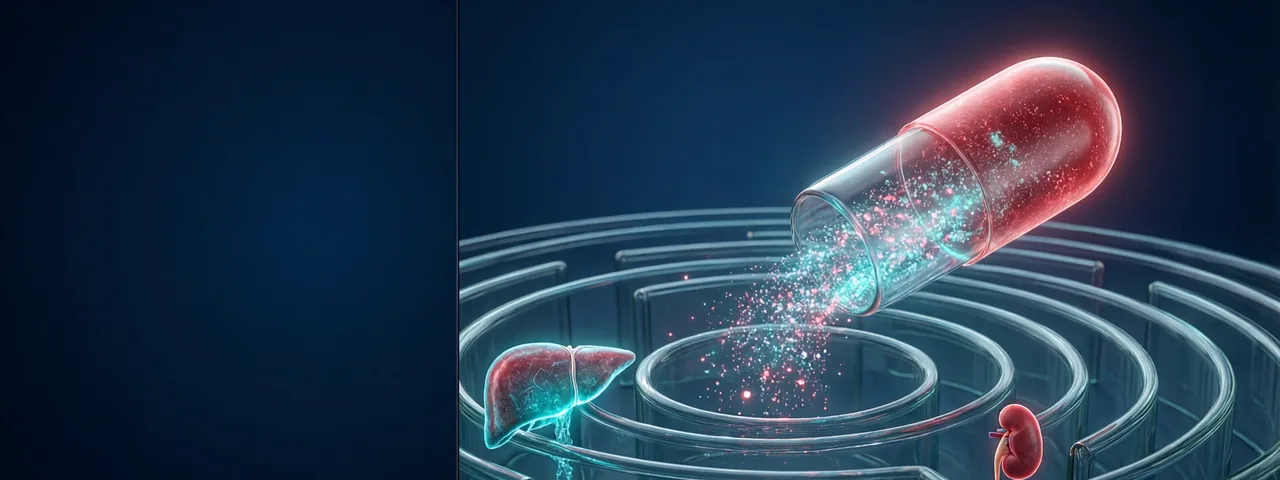
Drugs and their metabolites do not stay forever. They are removed by excretion. The most important organs are the kidneys, which clean the blood and send the waste out in urine. Some drugs also leave through bile into the gut and out with the faeces, and a few volatile substances are breathed out. (The Human Body lab's kidney lesson shows how the organ works.)
The kidney handles a drug with three processes in each tiny filter unit (nephron):
1. Filtration. Blood pressure pushes water and small dissolved molecules out of the blood in the glomerulus. Large things like blood cells, and drug molecules stuck to albumin, stay behind. About 180 litres of fluid are filtered per day in a healthy adult, and nearly all of it is reclaimed.
2. Secretion. Transporter proteins pump some drugs from the blood into the tubule, adding to what was filtered.
3. Reabsorption. The tubule takes back water and useful molecules. A drug that dissolves in fat can slip back into the blood, which slows its loss. Water-soluble metabolites are left behind in the urine, which is one reason the liver converts drugs into them.
The speed of removal is called clearance (CL): the volume of blood cleared of the drug per unit time.
Clearance links to the half-life you will meet in World 2:
t½ = 0.693 × Vd ÷ CL
If the kidneys work less well, clearance falls and the half-life becomes longer: the drug stays and accumulates with repeated doses. This is why doctors check kidney function when a drug leaves the body mainly that way. Choosing the amount and timing for a particular person is a medical decision.
A common idea is that drinking lots of water flushes a drug out quickly. Kidney clearance of most drugs is set by filtration, secretion and reabsorption, not by how much you drink, so extra water does not speed it up in any dependable way, and drinking huge amounts of water can itself be dangerous.
If the kidneys clear a drug less well, the half-life will be...
Which kidney process puts a drug into the urine from the blood in addition to filtration?
Why do doctors adjust medicines for people with reduced kidney function?
Does drinking extra water reliably remove a medicine from the body faster?