Spreading out
Distribution
Teaching this? Open projector mode
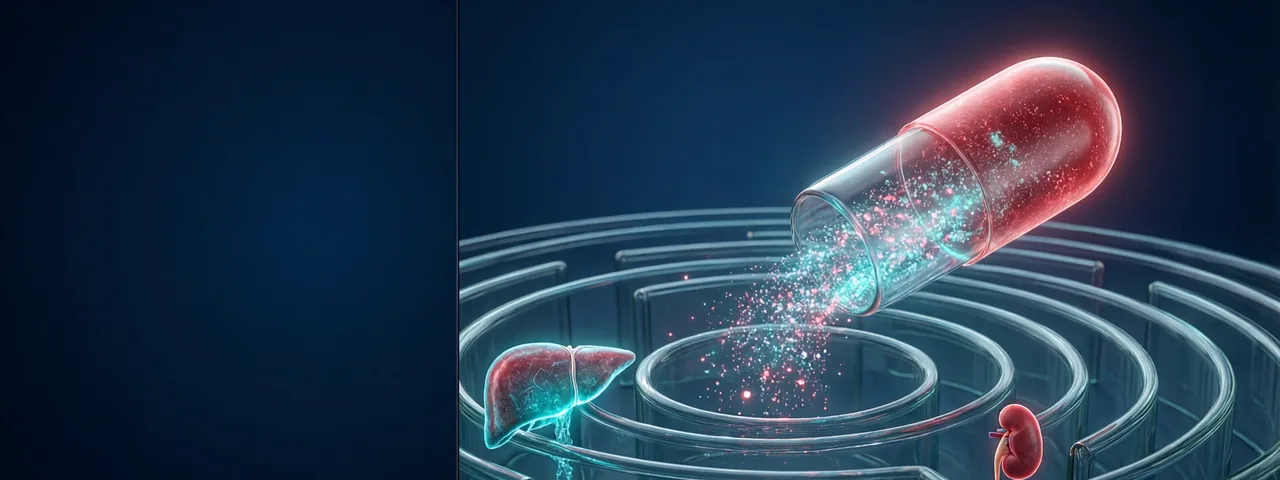
Once a drug is in the blood, the heart pumps it round the whole body in about a minute. From the blood it distributes into the tissues: muscle, fat, organs, and, depending on the drug, the brain. The more a drug leaves the blood and sits in tissues, the less of it stays in the blood to be measured.
Pharmacologists summarise this with one number, the volume of distribution, Vd:
Vd = dose ÷ C₀
where C₀ is the blood (plasma) concentration right after an IV dose has mixed. Example, with made-up numbers: dose = 100 units, C₀ = 2 units/L gives Vd = 100 ÷ 2 = 50 L.
For scale, an adult has about 5 L of blood, of which roughly 3 L is plasma, and about 40 L of water in total. A Vd of 50 L is more than all the water in the body! This tells you Vd is not a real volume. It is the apparent volume you would need for the drug to have the concentration seen in the blood. A big Vd means the drug has left the blood and is sitting in tissues (often fat-soluble drugs). A small Vd, near the plasma volume, means it mostly stays in the blood.
Two more things shape distribution:
- Binding to blood proteins. Many drugs stick to a protein called albumin in the plasma. Only the free (unbound) fraction can leave the blood, reach the target and act. The bound part is like a reserve. The balance shifts when the free drug is used up.
- Barriers. The blood-brain barrier is made of capillary cells joined by very tight seals, with special pumps that push many molecules back out. It protects the brain from toxins and most blood-borne chemicals. For a drug meant to act in the brain it is an obstacle; for a drug meant to act elsewhere, it is a welcome safety feature.
A drug has a very large volume of distribution. Where is most of it?
Which part of a drug in the blood can leave the bloodstream and act on its target?
A dose of 60 units gives C₀ = 3 units/L. What is Vd?
True or false: Vd is the real physical volume that a drug fills inside the body.