The liver's first pass
Metabolism
Teaching this? Open projector mode
Everything absorbed from the gut travels first in the portal vein to the liver before it joins the general circulation. The liver is the body's main chemical processing plant. It carries enzymes that change foreign molecules, including drugs. This is metabolism. (The Human Body lab's liver lesson covers the organ itself.)
The best-known group of drug-metabolising enzymes is the cytochrome P450 family, usually written CYP. In general the liver changes a drug into metabolites that dissolve better in water, which makes it easier for the kidneys to remove them.
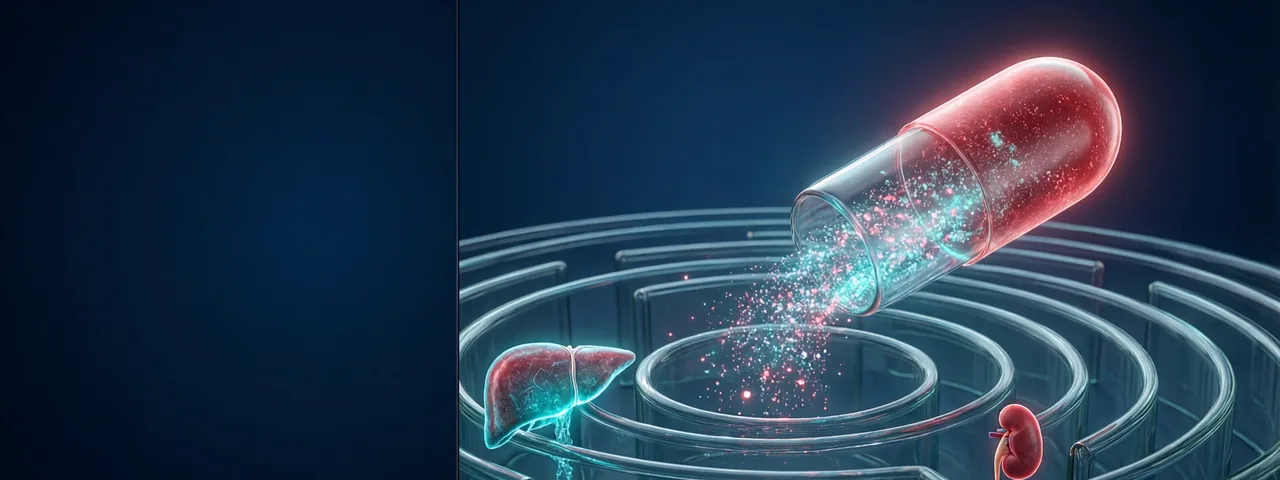
Because a swallowed drug passes through the liver before reaching the rest of the body, the liver may remove a part of it before it gets anywhere. This is the first-pass effect. If the liver removes a fraction E_h (the hepatic extraction), then:
F = F_abs × (1 − E_h)
where F_abs is the fraction that crossed the gut wall. Example with made-up numbers: F_abs = 0.9 and E_h = 0.6 give F = 0.9 × 0.4 = 0.36. A drug with high first-pass loss may need a much larger dose by mouth than by vein, or a route that skips the first pass: sublingual and transdermal drugs go into veins that reach the heart without visiting the liver first, and IV drugs bypass it entirely.
Metabolism is not simply "making the drug harmless":
- Most of the time it inactivates the drug or makes it easier to excrete.
- Sometimes the metabolite is still active, or even more active.
- A prodrug is a medicine that is inactive until the body converts it, which is how it is meant to work. Prodrugs can help a drug to survive the gut or to be absorbed better.
- Occasionally a metabolite is toxic. Doctors take this into account when they choose and monitor a medicine.
People differ in enzyme activity, because of genes, age, liver health and other medicines (World 3).
What is the first-pass effect?
F_abs = 0.8 and E_h = 0.5. What is F?
Why can a sublingual drug avoid the first pass?
What is a prodrug?