Pitch, Octaves and the Twelve Notes: How Music Works
Why pitch is frequency, why an octave doubles it, how twelve equal steps divide that octave, and how beat and tempo organise time. With a live sound lab.
A piano has 88 keys, but only twelve different notes. Every other key repeats one of them, higher or lower. Behind that neat pattern sits plain physics: vibration, frequency and one very clever piece of arithmetic. This guide connects the keys you press to the numbers underneath.
Pitch is how fast something vibrates
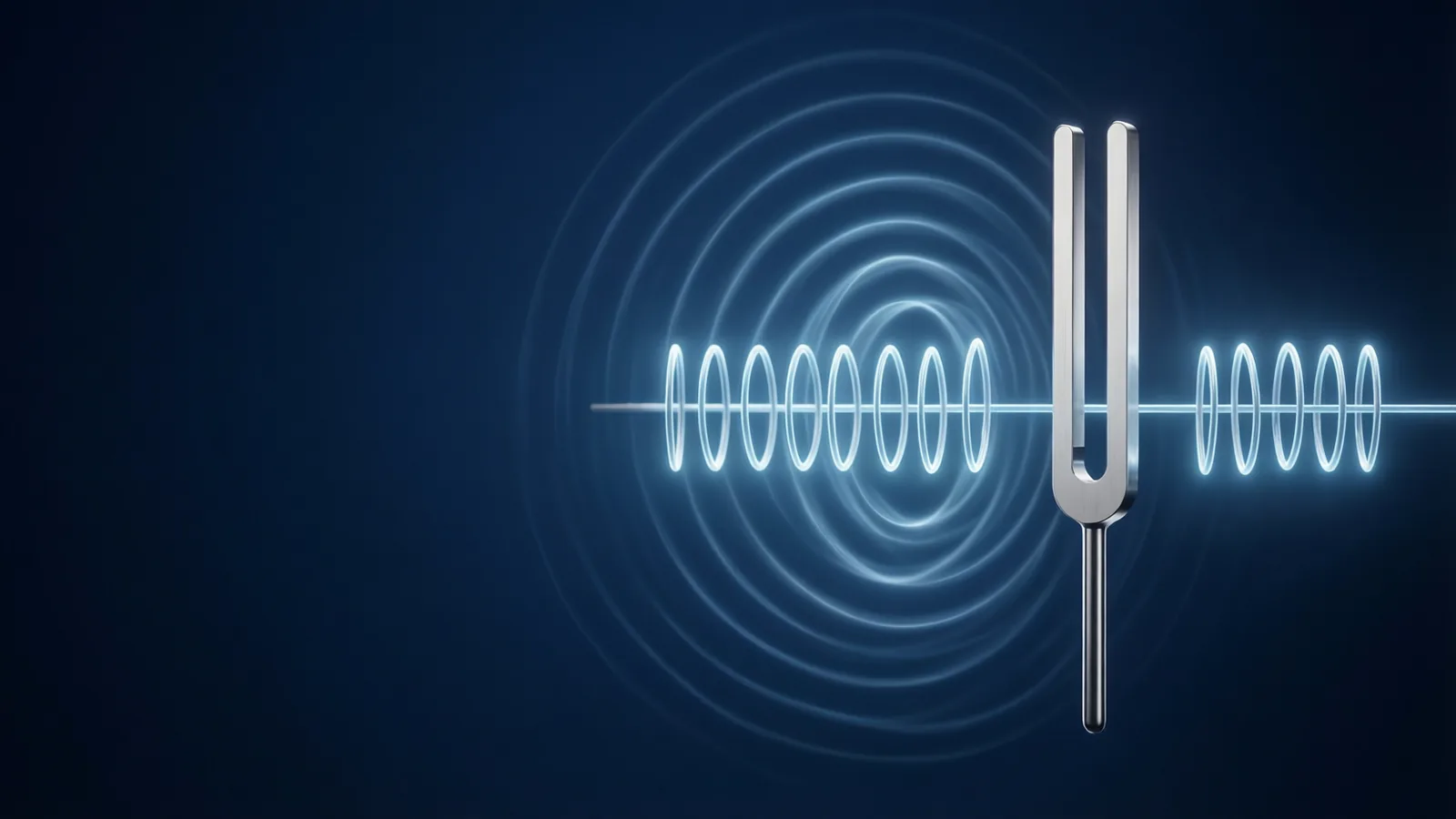
Sound is a vibration travelling through air. A guitar string, a vocal cord or a speaker cone pushes the air back and forth, and your ear picks up the pattern.
The speed of that back-and-forth is the frequency, counted in hertz (Hz), which means cycles per second. We hear frequency as pitch: faster vibration sounds higher, slower sounds lower. The reference note most orchestras tune to, the A above middle C, vibrates 440 times each second.
Loudness is a separate thing. It depends on the amplitude, the size of the vibration. A note can be high and quiet or low and loud, and the two settings are independent.
The octave: why two Cs sound like the same note
Play a C, then the next C up the keyboard. They sound like the same note at different heights. The reason is a clean ratio: the higher C vibrates at exactly twice the frequency of the lower one.
That doubling is the octave. Go up another octave and you double again. Going down halves the frequency. Middle C is about 262 Hz, the C above it about 523 Hz, and the next about 1046 Hz.
Notice that the octave is a multiplication, not an addition. Going up one octave from a low note adds a few dozen hertz; going up one from a high note adds hundreds. Our ears judge pitch by ratios, which is why the keyboard looks evenly spaced even though the frequencies are not.
Twelve notes inside one octave
Count every key, white and black, from one C up to the next and you pass through twelve different notes before the pattern repeats. Playing them in order gives the chromatic scale.
Each step between neighbouring keys is a half step (or semitone), the smallest step on a standard keyboard. Two half steps make a whole step. The black keys come in groups of two and three, which gives you landmarks: the white key just left of any pair of black keys is always C.
A black key can have two names. The one between C and D is C♯ when you think of it as C raised, and D♭ when you think of it as D lowered. Same key, same sound, different spelling.
The twelve letter names (with sharps or flats) are the palette. Melodies, chords and scales are all built from choosing among them.
Equal temperament: dividing the octave fairly
Here is the puzzle. If an octave doubles the frequency, and it holds twelve equal half steps, what does one half step multiply the frequency by? Call it r. Twelve of them in a row must equal 2:
r¹² = 2, so r = 2^(1/12) ≈ 1.0595
Every half step is about 6 percent higher than the one below. Twelve steps compound back to exactly double. This system is 12-tone equal temperament, and it is the tuning of nearly all modern pianos and keyboards.
Why bother? Because it lets you play in any key and have every interval sound the same. Older tuning systems made some keys sweet and others harsh. Equal temperament accepts tiny compromises everywhere in return for freedom to modulate anywhere. A perfect fifth, for instance, is ideally a 3:2 ratio (1.5), but in equal temperament it is about 1.498, a difference most listeners barely notice.
Rhythm: when and how long
Pitch is about which note you hear. Rhythm covers the timing: when each note starts and how long it lasts.
Underneath most music is a steady pulse called the beat. How fast it goes is the tempo, measured in beats per minute (BPM). At 60 BPM you get one beat per second; at 120 BPM, two.
Note lengths are fractions of the beat. If a quarter note gets one beat, as in 4/4 time, then a half note lasts two beats and a whole note four. Eighth notes squeeze two into one beat.
You can see a link back to frequency here. A tempo of 120 BPM is a pulse of 2 Hz, only far too slow to hear as a pitch. Speed the pulse up past about twenty cycles a second and it blurs into a tone.
Common misconceptions
- "Higher notes are louder." Pitch is frequency; loudness is amplitude. They are independent.
- "Each octave adds the same number of hertz." It multiplies by two, so the gaps in hertz grow as you go up.
- "Black keys are the odd ones out." They are ordinary notes. The keyboard just shows the uneven pattern of whole and half steps.
- "C♯ and D♭ are always identical." On a piano they are the same key. In some other tuning systems and on some instruments, they can differ slightly.
How to explore this in the lab
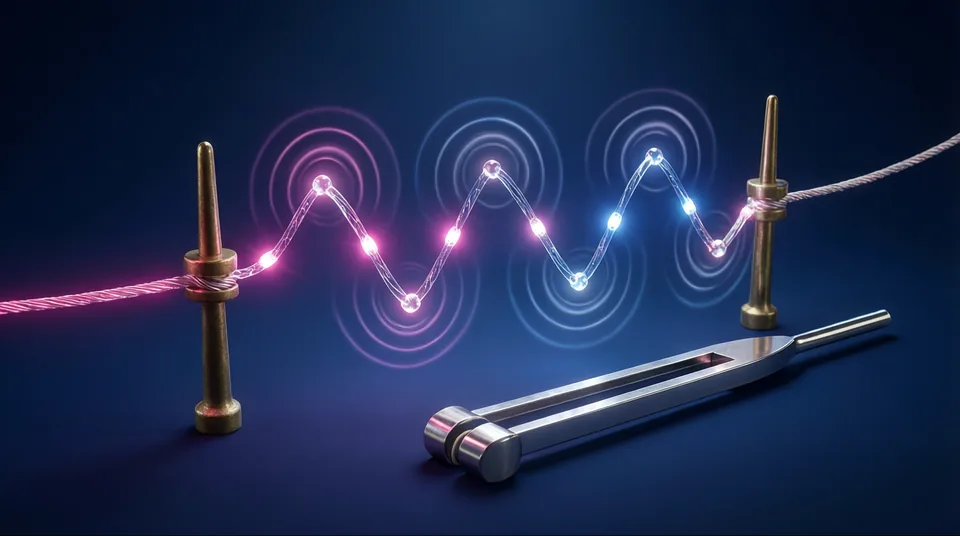
The Sound & Music Lab gives you a keyboard that names each interval and a string you can watch vibrate. A good path through the free first world:
- What is pitch? ties sound to vibration and frequency.
- The octave shows the doubling for yourself.
- The twelve notes walks the chromatic scale.
- Equal temperament puts the twelfth root of two to work.
- Beat & rhythm moves from pitch to time.
The lab uses idealised tones, which are cleaner than a real instrument, so it works as a simplified teaching model rather than a recording of one.
- Pitch is frequency; loudness is amplitude, and the two are independent.
- An octave doubles the frequency, so the same note sounds higher.
- There are twelve notes per octave, separated by half steps.
- In equal temperament each half step multiplies frequency by 2^(1/12), about 1.0595.
- Tempo in BPM sets how often the beat arrives; note lengths are fractions of it.
What is pitch?
High, low, and frequency. About 5 minutes. Free, no account, runs in your browser.
More free lessons from this guide
Simulations on Novareka are teaching models, simplified on purpose. They show how an idea behaves; they are not a substitute for professional, medical or engineering advice.
Labs in this guide
Keep reading
All guides → Explainer
 Explainer
 Explainer